Graded cards face two catastrophic threats that every other protection layer in the hobby ignores: fire and water. Sleeves, bumpers, cases, and UV glazing all defend against slow damage — abrasion, light, dust, humidity — but none of them survives a house fire that routinely exceeds 600 degrees Celsius, and none of them floats. A graded slab in a $150 display case on a shelf is exactly as vulnerable to catastrophe as a raw card in a shoebox, because both are made of materials with the same thermal limits. The strategies below address the two disasters directly: what actually survives them, what hardware prevents them, and how the market for that hardware has evolved.
The Thermal Reality: The 350-Degree Line
Everything in a card collection dies at the same temperature line. Cardboard and card stock char around 350 degrees Fahrenheit; slab plastic warps and its seals fail at far lower temperatures, roughly 130 degrees in a sealed car and well below ignition in a real fire; paper currency and cards cross their destruction threshold at about 450. House fires, meanwhile, routinely blow past 600 degrees Celsius — over 1,100 Fahrenheit — in the first minutes. The gap between what your cards can survive and what a fire delivers is bridged by exactly one consumer product category: fire-rated safes engineered to hold their interior below that critical line. The 2026 safe-buying guidance for card collectors states the requirement plainly: house fires exceed what raw card stock and toploader plastic can survive unprotected, and a fire safe rated to keep internal temperature under roughly 150 degrees Celsius is built for exactly that gap.

The chart frames the stakes. A UL 350-rated safe — the classification that governs paper and document protection — holds its interior below 350 degrees for a rated duration while the exterior endures 1,550 to 1,800 degrees, tested units on the 2026 market run from half an hour to ninety minutes at those temperatures.
The Fire Strategy: Rating, Duration, and the Details
The fire-protection specification has three layers. First, the rating: demand UL 350 or its international equivalents — a classification that means the interior stays below the paper-destruction threshold, unlike gun safes and general security safes that carry no document-class fire rating at all.
Second, the duration: thirty minutes is the budget floor — enough for most residential fires to peak and pass — with sixty minutes the comfortable standard and ninety minutes the premium tier, all at exterior temperatures between 1,550 and 1,800 degrees. Third, the details that determine whether the rating survives contact with reality: bolt the safe down, because an unanchored safe can simply be carried out during a break-in regardless of build quality, and add a desiccant pack inside, because fire-rated safes use insulation that holds moisture after a heat event — and that trapped humidity warps cards over time.
Two warranty features deserve attention in the purchase decision. Leading manufacturers back their chests with lifetime after-fire replacement — Honeywell's file chest, for instance, pairs a 100-hour submersion waterproof seal with a UL 60-minute rating at 1,700 degrees and promises a free replacement unit if it's ever fire-damaged.
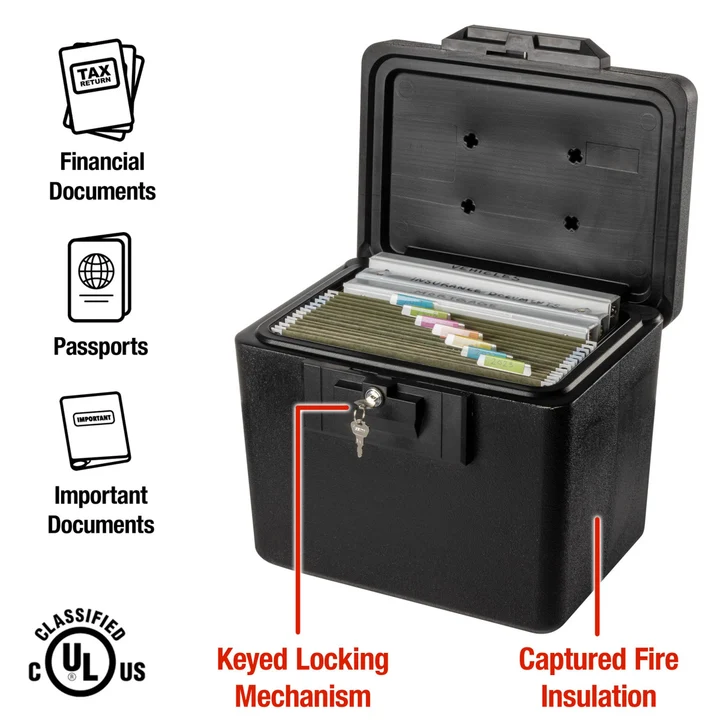
The chest above — UL-classified, keyed locking mechanism, captured fire insulation, sized for hanging folders that also happen to fit slab binders and stacked toploaders — represents the entry point of serious fire protection at roughly $40 to $80, the tier where most collections should start.
The Water Strategy: Gaskets, Submersion, and Placement
Water damage earns equal billing because it strikes far more often than fire and from directions collectors rarely anticipate. Insurance-industry data attributes roughly 45 percent of interior property damage claims to water, and the sources are mundane: burst pipes, appliance failures, roof leaks — and, perversely, firefighting, where the water that saves your house floods the room your collection lives in.
The water-protection stack has four layers. First, the enclosure: gasket-sealed chests rated for actual submersion — tested units on the market document contents staying dry under a meter of water for 24 to 100 hours, a specification distinct from the vague "water-resistant" claim.
Second, placement: off the floor on a shelf or stand, because the first water in any room event arrives at floor level, and out of basements entirely — memorabilia conservation guidance is explicit that basements are the most water-susceptible storage zone in any home. Third, detection: water leak sensors with automatic shut-off valves cost less than one slab and address the claim category that dominates the statistics. Fourth, the safe-within-a-safe discipline: graded slabs travel inside sealed foam cases inside the fire chest, so the gasketed layers multiply rather than substitute.
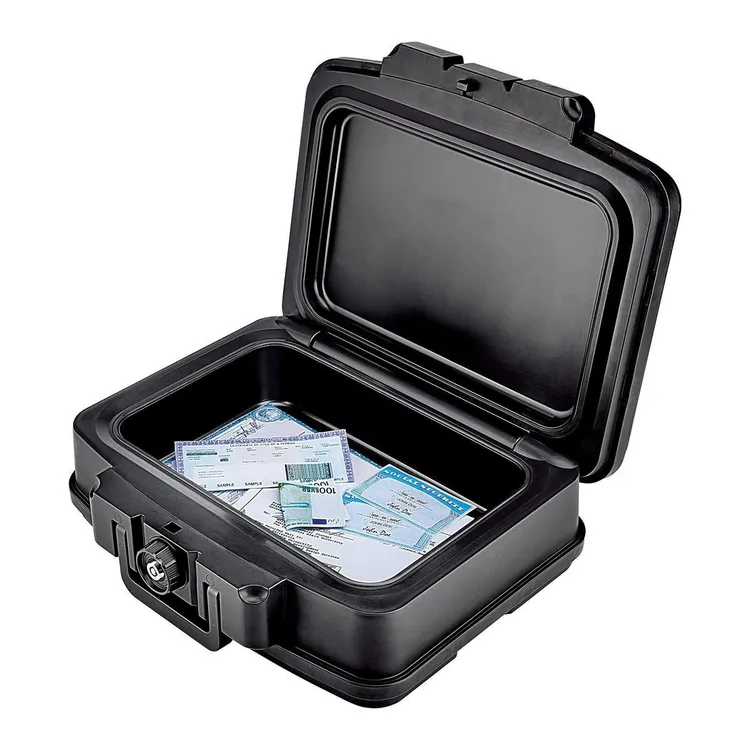
The gasket-sealed chest above — compression latches, captured insulation, barrel-key lock — illustrates the dual-rating format the 2026 market has standardized on: thirty minutes at 1,550 degrees and a 24-hour seal against 38 inches of water, in a unit rated 4.5 stars across hundreds of verified reviews and priced for the mass market.
Market Analysis: A Dual-Threat Category at Scale
The hardware market behind these strategies is large and growing. Fire-resistant safe industry data projects a compound annual growth rate above 5 percent, with climate-related flooding events explicitly identified as a demand driver for dual-protection units — the same dual-rating format card collectors need. Supply aggregators index more than 34,000 fire and waterproof safe products from over 13,000 suppliers, with consumer units ranging from $39 document boxes to $1,200-plus institutional cabinets.

The product-trend data describes the category's direction: a measurable shift from "water-resistant" marketing language toward IP67 and IP68 certified submersion ratings, intumescent seals and composite insulation extending fire endurance, and smart-lock integration adding audit trails — features migrating from commercial document protection into consumer units priced for collections.
User Analysis: Who Needs Which Tier
Four collector personas map onto the disaster-protection ladder.
The budget collector owns two to four figures of graded value and rents. His correct tier is the $40–$80 dual-rated chest — bolted or hidden, desiccant inside, off the floor — plus a cloud-backed photo inventory, because the chest's cost is less than one reholdering fee while its protection covers the whole collection.
The homeowner collector with a growing vault faces the next decision: once the collection includes multiple slabs with real resale value, guidance from the safe specialists is that a combined burglar-and-fire-rated unit matters as much as fire protection alone, because the two threats share the same hour.
The high-value investor at five figures and above operates the institutional model: a combined-rating safe or bank safe-deposit box for the blue-chips, itemized insurance with scheduled coverage, and appraisals refreshed every few years — the documentation discipline that insurers of memorabilia specifically require before claims, not after.
The multi-location collector — pieces at home, at a parent's house, in a storage unit — needs the redundancy audit: every location held to the same minimum standard, because a collection's disaster exposure is set by its weakest site.
Operational Structure Analysis: Supply Chain and the Documentation Layer
Two operational realities shape what reaches the collector's shelf. The manufacturing layer is concentrated — Chinese factories dominate production across price points, with Southeast Asian capacity growing — which keeps consumer dual-rated units affordable but makes certification verification the buyer's job: UL, ETL, JIS, and EN ratings must be checked per model, because marketplace listings borrow the language freely. The distribution layer has normalized the sub-$100 dual-rated chest through mass-market hardware retail, while the premium tier — UL 72-350 two-hour safes with IP-rated submersion and touchscreen locks — sells brand-direct. Above both sits the documentation layer, which collectors control entirely: photographed inventory with cert numbers, values, and purchase records stored in a fireproof safe or the cloud, physically separate from the collection. The claims data is unambiguous — after a fire or flood, the collector with documentation recovers; the one without negotiates from memory.
Upgrade Iteration Data: Five Generations of Disaster Protection
The protection maturity curve has a measurable history.

Generation one was no protection — a closet or shelf, where both fire and water indexes sit near zero. Generation two added plastic bins, solving dust while changing nothing about heat and barely touching water. Generation three brought the fire-resistant box era, with consumer chests at $40–$80 lifting fire protection dramatically but leaving water to gaskets that didn't always seal. Generation four paired UL-rated safes with desiccant discipline and bolt-down installation, pushing fire protection to institutional levels while water protection caught up through submersion-tested seals. Generation five — the 2026 standard — combines fire and burglary ratings with IP-certified waterproofing, layers documented insurance on top, and adds leak detection and automatic shut-off valves at the room level. Each generation's cost was less than the value of what it protected; the curve's lesson is that disaster protection is the cheapest upgrade per point of risk reduction in the entire hobby.
The composite above shows the category spread in one frame: the grab-and-go fireproof bag for evacuation scenarios, the classic keyed chest for the closet shelf, and the digital-lock safe for the bolted-down vault tier — three answers to the same question, priced for three collection sizes.
The Deployment Playbook
The operational sequence, in order. Inventory first: photograph every slab and record cert numbers to the cloud before buying anything. Buy the dual-rated chest sized for the archive tier — sixty-minute UL 350, submersion-tested seal, under $100 for most collections. Bolt it down or conceal it. Add desiccant on a renewal schedule and check it at every quarterly audit. Keep the displayed rotation tier in its UV-rated cases, accepting that display and total disaster protection are different tiers — the wall display rotates quarterly into the chest. Raise the chest off the floor on a stand. Install a leak sensor if the collection lives anywhere near plumbing. And at five figures of value, schedule the collection on insurance and consider the combined-rating safe or bank box for the blue-chips.
Common Mistakes
Assuming the display case is protection. Display cases are for light, dust, and handling. Fire and water pass through them as if they weren't there.
The "fireproof means waterproof" assumption. The industry explicitly flags this as the most common misconception — most fire-rated safes are not waterproof unless specifically tested and certified for it.
Skipping the desiccant. Fire-safe insulation traps humidity; collectors who skip the desiccant pack trade a fire risk for a slower warping risk inside their own safe.
Unanchored safes. A safe that isn't bolted down is a portable asset for whoever finds it first — anchoring is part of the rating, not an accessory.
No records offsite. A fire that takes the collection takes the paperwork in the same room. The inventory lives in the cloud, or it doesn't exist when it's needed.
Basement storage. The single highest-risk room for the water threat, and the first place floods reach. Collections belong on interior, elevated, climate-stable ground.
Conclusion
Fire and water are the only threats in the hobby that end collections outright — no reholdering, no restoration, no insurance negotiation recovers a melted slab. And they're the only threats with a complete, affordable, off-the-shelf defense: a $40-to-$150 dual-rated chest, bolted down, desiccated, elevated, and paired with a cloud inventory, covers the overwhelming majority of collections, while the five-figure vault tier upgrades to combined-rating safes and scheduled insurance. Every other protection layer in the hobby optimizes value; these two strategies preserve existence. The graded cards that survive the next house fire or burst pipe won't be the lucky ones — they'll be the ones whose owners treated disaster as a solvable engineering problem instead of an acceptable risk. Sleeves prevent scratches, cases prevent fading, and racks prevent dust — but only the fire-rated, waterproof, documented system prevents the story from ending.