A unified frame turns a wall of trading cards from a do-it-yourself project into a single composed object — one mount, one mat, one glazing decision, one hanging, and a display that reads as designed rather than accumulated. Anyone who has lived with the alternative — six individual frames bought at different times, hung at six different heights, with six different nail holes in the drywall — already knows why the multi-card format wins. What they may not know is how far the category has matured: the 2026 unified frame market spans raw-card grid frames, EVA-cut slab frames, magnetic quick-swap units, and lockable cabinet frames holding thirty-plus cards behind UV-rated glazing, all at prices that make the DIY route look expensive. This guide covers the formats, the specifications, and the setup that gets ten or more cards on one wall as one piece.
Why One Frame Beats Many
The case for the unified frame is four-fold, and each fold answers a failure mode of the multi-frame approach. Composition: a single frame enforces the spacing, the alignment, and the rhythm that individual frames approximate and never quite achieve — the grid is the design. Swapping: one opening updates the whole wall — magnetic and EVA-slot frames let a rotation take minutes rather than an afternoon of re-hanging. Protection: one enclosure means one glazing decision, one seal, one UV specification covering every card at once, instead of six frames where the weakest glazing sets the wall's real protection level. And the wall itself: one hanging event, one set of anchors, one level-check — versus the patchwork of nail holes that individual frames leave behind when the arrangement inevitably changes. The buying-guide framing from the display industry states the layout logic plainly: collectors commonly choose single-card, three-card, nine-card, large feature walls, or custom arrangements, and a balanced layout allows every card to receive the attention it deserves.
The Four Format Families

The format comparison chart maps the field across capacity, cost, swap speed, and protection. The right choice depends on what's going on the wall — raw cards, graded slabs, or a mix — and how often the wall changes.
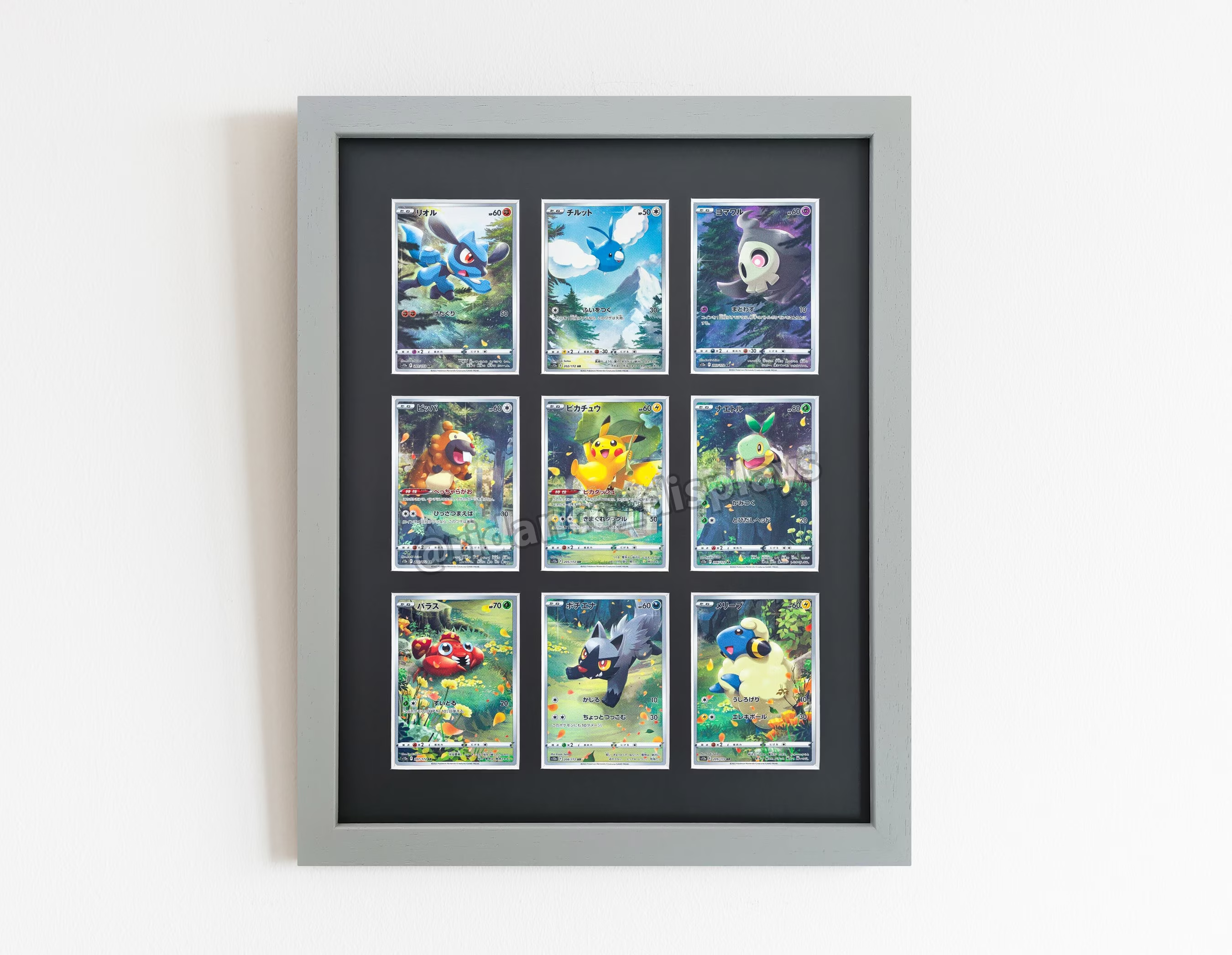
The frame above is the raw-card grid archetype: nine slots behind glazing in a grey moulded frame with a black mat, Japanese-language cards reading beautifully against the neutral field. The buying guide's format advice applies verbatim: raw cards are ideal for displaying favorite artwork, complete subsets, and personal collections — and for raw walls, the mat-board grid is the format that makes nine cards read as one composition. Tempered-glass and wooden variants hold up to ten standard cards and bring the furniture-grade look, with the honest caveat that raw-card frames aren't sized for graded slabs without adjustment.
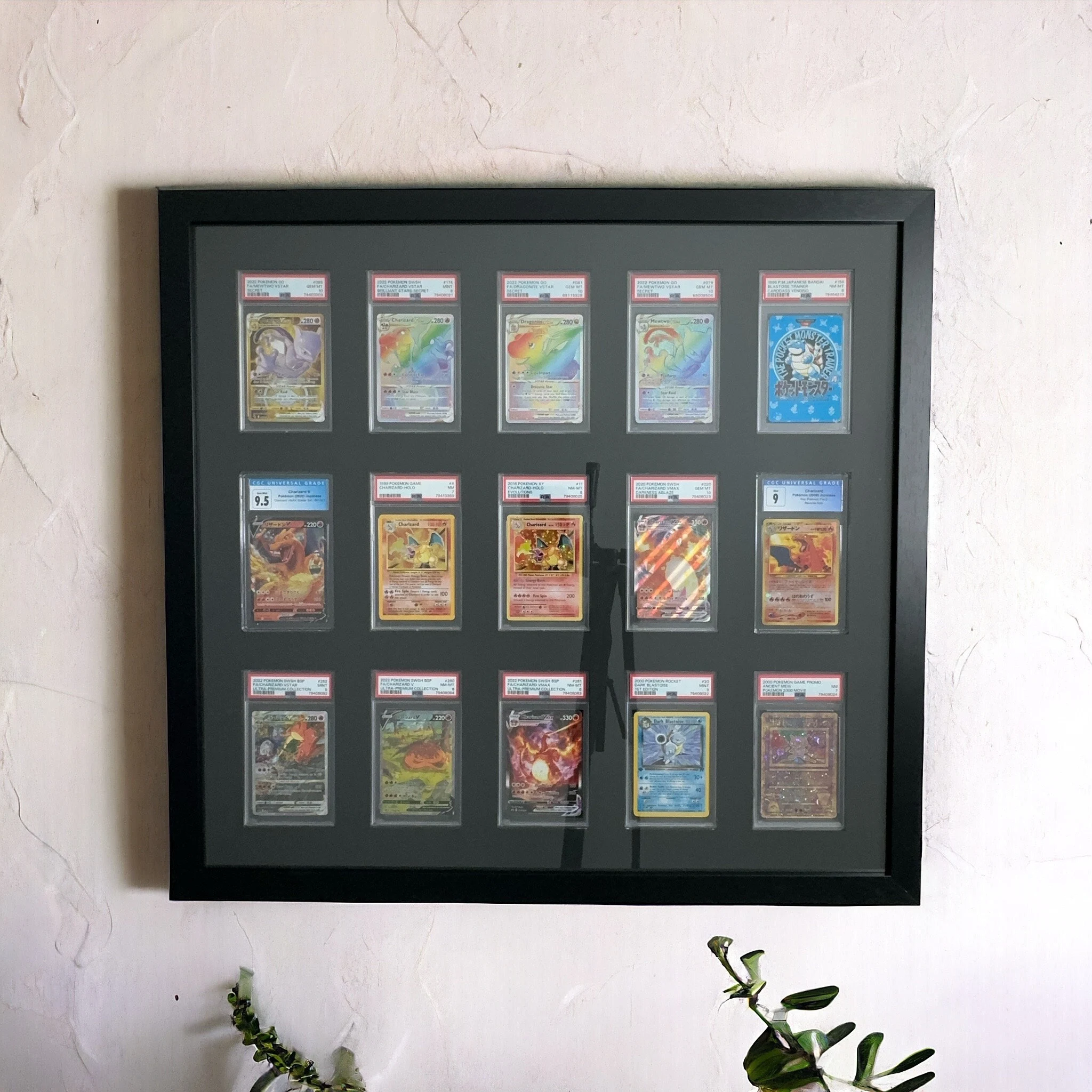
The frame above is the slab-grid archetype — the fifteen-slot custom build that anchors most serious walls: PSA and CGC slabs seated in precision-cut openings on a dark mount, hung as a single object above a sideboard with a plant doing the gallery framing. Handcrafted twelve-opening variants with UV protection available define the premium tier of the same family.
The slab-grid's key specification is the slot construction: EVA-cut frames hold slabs at the ideal display angle in soft elastic that protects the case, work like a picture frame — remove the back panel, place the cards, reassemble, hang — with no tools, and grader-agnostic fit across PSA, CGC, and TAG in the better units.
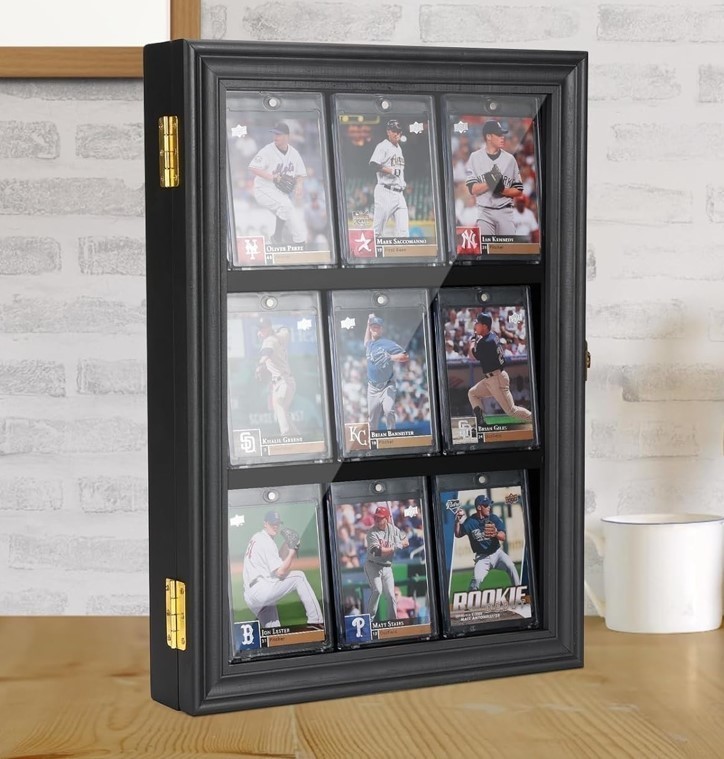
The hinged cabinet frame above bridges grid and case: nine toploaded cards behind a glass-fronted wooden frame with gold hinges — the deep-profile construction that lets raw cards display behind glazing with the furniture aesthetic of a shadow box. The buying checklist for this family runs to the security features: UV protection, lockable closures, and the wall-mount or tabletop versatility that the display guides rank first.
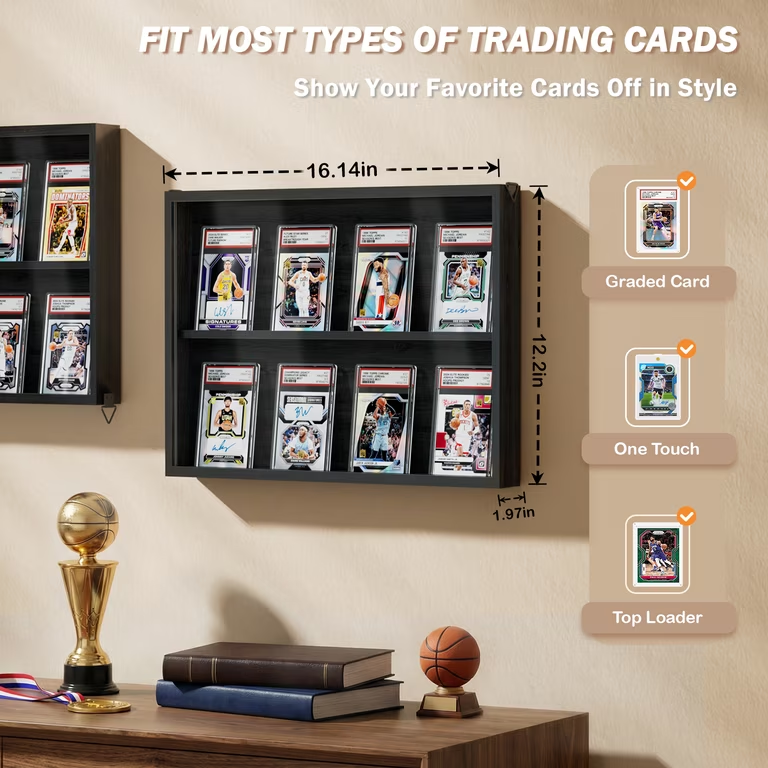
And the shelf-frame above shows the flexible tier: open-backed wall shelves sized for graded slabs, one-touches, and toploaders interchangeably — the format that accepts whatever the collection's mix looks like this quarter. The two-pack above markets its compatibility explicitly across graded cards, magnetic one-touches, and standard toploaders, which is the honest answer for collections still in transition between raw and graded.
The ceiling of the category is the five-tier cabinet case: thirty-five slabs in a 30-by-24-inch footprint, shatterproof acrylic at 92 percent transparency and 98 percent UV protection, forward-opening panel for access without dismounting, edge lips keeping cards from slipping, and a locking hasp — the format that makes a unified frame indistinguishable from a museum vitrine.
The Specifications That Matter
Six specifications decide whether a unified frame protects or merely presents. UV rating with a published percentage — 95 percent minimum, 98 to 99.6 percent the premium tier — covering the entire aperture, not just a coated center. Slot construction: EVA for slabs (soft, grippy, display-angled), magnetic holders included or compatible for raw cards, with grader-agnostic fit if the collection mixes grading companies. Access: magnetic quick-swap faceplates or forward-opening panels for rotation-friendly walls; hinged doors with locks for security-first walls. Mount quality: real hanging hardware rated for the loaded weight — the most common failure in reviews is mounting hardware that fights the installer, so budget for your own anchors when the included hooks disappoint. Edge retention: lips or grooves keeping cards from sliding when the frame vibrates or the door opens. And depth: the cabinet frames' 1.2-to-2.4-inch profiles accommodate toploaders, one-touches, and slabs, where the flat grid frames take sleeved raw cards or slim holders only. The magnetic quick-swap tier deserves special mention for rotation collectors: the faceplate removes to update the display in seconds without taking the frame off the wall, keeping the setup looking professional while making it effortless to organize an evolving collection.
The Setup: From Box to Wall
The build sequence in six steps. First, curate the lineup before the frame arrives: nine, twelve, fifteen, or thirty-five slots means the curation decision happens at the desk, not during installation — anchor card at center or left-third, supporting pieces radiating, and if the frame mixes raw and graded, group by format within the grid for visual coherence. Second, audit the wall: interior wall away from window light, the 57-inch center height if hanging standalone, four to eight inches above furniture if hanging over it, and the afternoon sun-map done before any holes. Third, verify the load: a loaded 35-slab cabinet case runs fifteen to thirty pounds — studs or fifty-pound-rated anchors, mounted empty, then loaded. Fourth, prep the cards: sleeves on everything, slabs sleeved and checked, nothing entering the frame bare. Fifth, load and seal: EVA slots or magnetic holders seated square, glazing film peeled, door or faceplate closed on a dust-free pass — the compressed-air-and-microfiber interior clean before sealing, because anything trapped inside stays inside. Sixth, light it: LED picture light or strip at the 30-degree rule, dimmable, on a timer — the unified frame's glazing manages reflections, but the beam still needs aiming.

Market Analysis: The Multi-Card Engine
The market data confirms where the growth is. Grid frames — the 9/12/15-card formats — have been the category's growth engine at roughly 40 percent annually since 2022, with cabinet frames close behind at 33 percent and single frames and ledges trailing at 14. The demand driver is the same one running through the whole display market: the grading boom means more slabs, and slabs want composed walls, not scattered ones. The supply side has stratified into three tiers: the commodity tier (Amazon and Walmart grid frames at thirty to ninety dollars), the custom tier (Etsy and small-shop handcrafted frames at sixty to two hundred, with UV upgrades and grader-specific sizing), and the cabinet tier (the 20-to-35-slot lockable cases at seventy to a hundred fifty). The specification-transparency wave reached this segment too — published UV percentages now appear on commodity listings, and the brands that can't publish a number increasingly lose to the brands that can.

User Analysis: Four Wall-Builder Personas
The unified-frame buyer divides into four profiles. The completionist — the set-builder with nine or fifteen slots' worth of a subset — wants the grid frame that presents the set as a set: sequential order, uniform spacing, the composition doing the curating. The rotator — the collector with a living top-ten — wants the magnetic quick-swap tier above all, because a wall that updates in seconds gets updated, and a wall that takes an afternoon fossilizes. The guardian — the high-value collector — wants the cabinet tier: locks, gaskets, 98-percent glazing, and the one-object custody posture that insurance files recognize. And the renter — the collector who can't drill — wants the adhesive-mount grid frames under five pounds, or the tabletop-stand configuration that the better units include; the market's versatility tier exists largely for this profile.
Operational Structure Analysis: Why the Category Converged
The supply side's convergence explains the category's sudden maturity. The framing industry contributed the grid-and-mat craft; the slab-case industry contributed the EVA slot cutting and the UV specification discipline; the furniture industry contributed the cabinet frames' joinery and locks; and the marketplace layer — Etsy small shops, Amazon brands, the handcrafted Colorado workshops — stratified the price points so every budget finds its tier. The standardization story is the quiet one: grader-agnostic slot sizing, the 35pt raw-card convention, and the published UV percentages have made the unified frame interchangeable across suppliers, which is why the category's growth compounds — a collector who outgrows a 9-slot grid moves to a 15-slot from any brand and the cards fit. The operational rule for the buyer: standardize the slot convention first (which holder format the frame accepts), and every later purchase interoperates.

Upgrade Iteration Data: Five Generations of the Multi-Card Wall
The wall's own history is a march toward the unified frame. Generation one was tape and tacks — cards stuck directly to the wall, edges destroyed, the lowest point on the quality index. Generation two was individual frames in a row — better protection, but the spacing chaos and the nail-hole patchwork made the wall look like what it was: an accumulation. Generation three was the DIY nine-pocket-page collage — the right instinct, no protection, dust included. Generation four was the first unified grids — real frames, real composition, but protection gaps and mounting headaches. Generation five — the current tier — is the unified cabinet frame: UV-rated glazing, lockable doors, EVA or magnetic slots, edge lips, and mounting hardware that mostly works. The index climbed from five to ninety-five across five generations, and the collectors on generation five describe the same conversion: they stopped rearranging the wall because the wall finally arranges itself.
Common Mistakes
Buying capacity before curation. A 35-slot frame with 20 slots filled looks emptier than a 15-slot frame full; size the frame to the lineup, not the collection.
Ignoring the UV number. Unrated glazing passes most UV regardless of how substantial it looks; the percentage is the purchase.
Mixing formats inside one grid. Raw beside graded beside one-touch reads as clutter; group by format for the composition the unified frame promises.
Trusting the included mounting hardware. The reviews across the category agree: budget for your own anchors, hang the frame empty, and load it after the level check.
Skipping the interior clean. One dust speck sealed behind the glazing is a permanent companion; the compressed-air pass takes a minute.
Hanging in sun's reach. The unified frame concentrates the wall's exposure into one object; the sun-map audit matters more, not less, when the frame holds everything.
Conclusion
The unified frame is where the multi-card wall finally became a product instead of a project — one object, one specification, one hanging, and a composition that reads as designed. The category's four format families cover every collection state: raw grids for the art-first wall, EVA slab grids for the graded wall, cabinet frames for the guardian, and the five-tier cases for the collection that's outgrown frames. The specifications to demand haven't changed: published UV percentages, grader-agnostic fit, edge retention, and mounting hardware worthy of the load. And the setup discipline is the same six steps that govern any wall — curate, audit, anchor, prep, seal, light. Ten or more cards on a wall used to mean ten decisions, ten holes, and a composition that never quite settled. One unified frame means one decision, two anchors, and a wall that finally looks like the collection deserves. The multi-card era didn't just simplify the wall — it completed it.