

KAAPAI racks represent the moment a card collection stops being inventory and starts being a collection — and this case study documents the exact transition that thousands of collectors are making in 2026: from the cardboard box era, where graded slabs live in closet darkness behind corrugated walls, to a racked, displayed, protected system where every card is visible, accessible, and shielded by museum-grade engineering. The collector profiled here went from nine BCW boxes in a bedroom closet to a full KAAPAI rack architecture in one weekend. The data from that transition tells the story of an entire market segment.
The Collector and the Problem
The subject of this case study is an archetype — call him the typical 2026 grader. Two years of PSA submissions, roughly 180 graded slabs, all of them living in standard cardboard storage boxes stacked in a closet. Nine boxes, six lids held shut by gravity, one index kept in his head.
The cardboard phase works until the day it doesn't, and the failure modes arrived in the order the hobby's own documentation predicts. Cardboard storage fails long-term protection on every axis: no UV protection, moisture absorption that warps stock and grows mold, zero defense against dents and stacking crush, and dust buildup that makes retrieval an archaeological event.
The discovery moment came during a reorganization, when he pulled a box he hadn't opened in months and found the classic cardboard signature: dust packed along the lid seam, and the top edges of the card rows showing the yellowed tinge that long-time box users describe from bitter experience — boxes turn the top edges of cards yellow and collect airborne debris, which is why veteran collectors report upgrading their boxes every five years whether they want to or not.
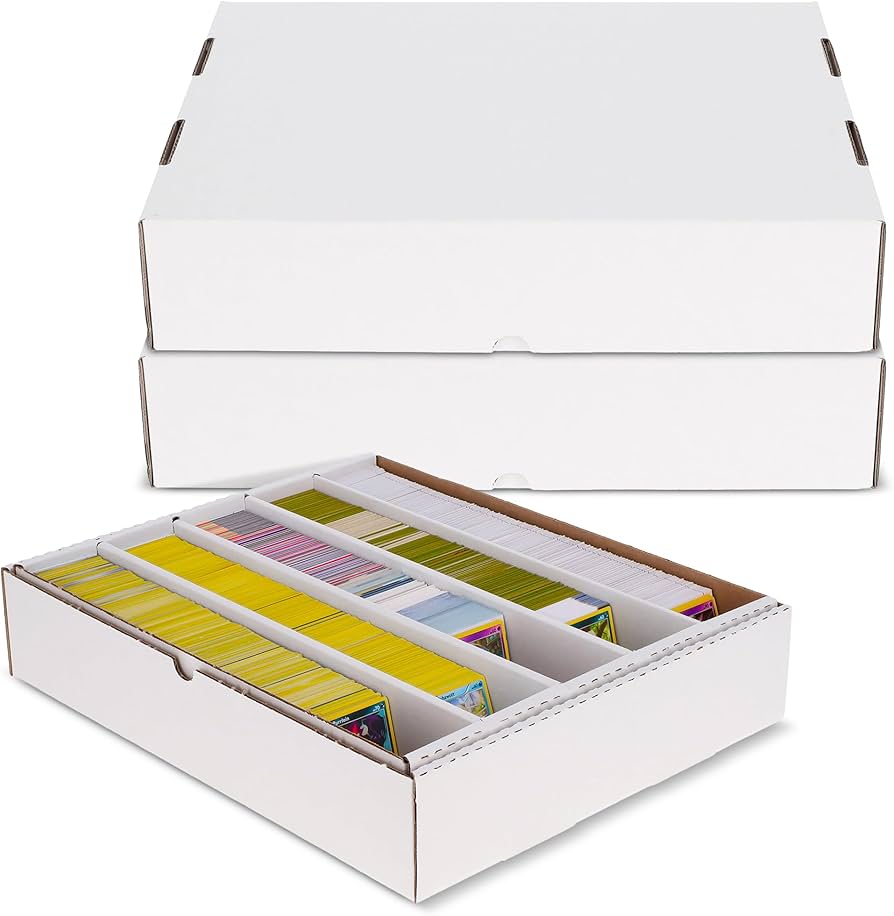
The boxes above — clean, new, photogenic — are exactly what the closet looked like on day one. What they look like at month eighteen is the problem: lid gaps admitting dust, corrugated edges abrading toploaders, and a collection that is functionally invisible. Retrieving one specific slab meant unstacking three boxes, opening two, and digging — eight minutes on a good day. He estimated he touched thirty of his 180 slabs in a year. The rest were in storage, not in a collection.
The Transition Plan: Audit, Triage, Rehouse, Display
The operational structure of a box-to-rack transition matters as much as the products, and the four-phase playbook runs the same for every collector at this stage.
Phase one, audit: every box opened, every slab sleeved and inventoried with cert numbers photographed — the documentation layer that storage guidance insists on before any container change, because the inventory is what converts a collection from memory into an asset.
Phase two, triage: the 180 slabs sorted into the three tiers the KAAPAI system is built around — display tier, working tier, archive tier. Tier decisions followed value and rotation logic: anything he'd show a guest went to display; anything actively traded went to working; the rest went to archive.
Phase three, rehouse: the archive tier moved from cardboard to gasket-sealed foam cases at 75–80 percent capacity — vertical, desiccant-managed, UV-opaque. Cardboard's failure modes don't transfer because the enclosure class changed entirely: sealed plastic blocks moisture exchange, foam absorbs impact, and opacity blocks 100 percent of light rather than filtering a percentage of it.
Phase four, display: the top tier went onto KAAPAI racks — the magnetic one-touch holders on tiered acrylic stands, the wall-mounted rack frames, and the single-slab display cases with published 99-plus percent UV filtration. This is where the transition stops being a storage upgrade and becomes a collection: every display position sits behind UV-filtering acrylic, because the slab itself was never going to provide that protection and cardboard never pretended to.
The Products: What Racked Looks Like
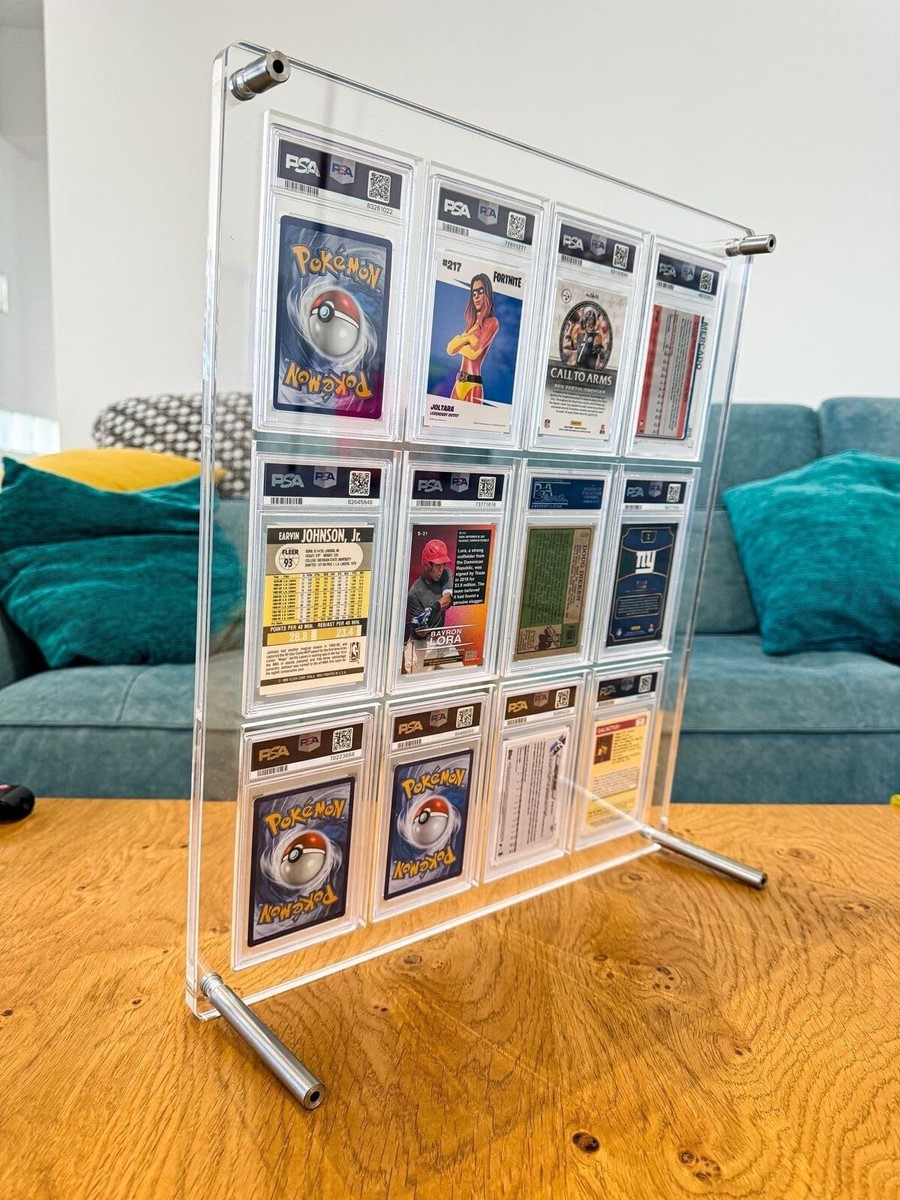
The free-standing acrylic rack above — twelve slabs in a three-tier frame with a weighted base — is the centerpiece tier of the post-transition system. What took nine boxes to hide now presents twelve slabs at eye level in a footprint smaller than a shoebox, and the swap time per card dropped from minutes of box archaeology to seconds of magnetic-lid access.
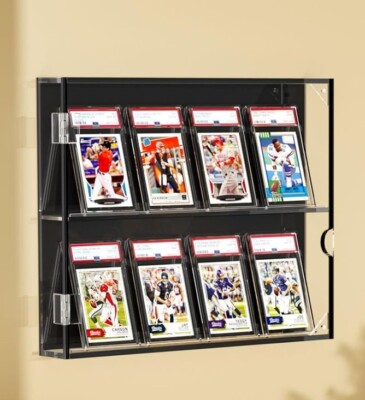
The wall-mounted rack — eight slabs behind a hinged acrylic door — is the zero-floor-space tier, hung at eye level on the office wall where the boxes used to lean in their stack. KAAPAI's own storage guidance frames the two environments as one system: archival inner sleeves for chemical protection, rigid slabs for structural support, and UV-filtering display cases as the outer shield, with museum-grade LED lighting replacing every incandescent and halogen source because traditional bulbs emit high UV and localized heat while LEDs produce almost zero UV and run cool.
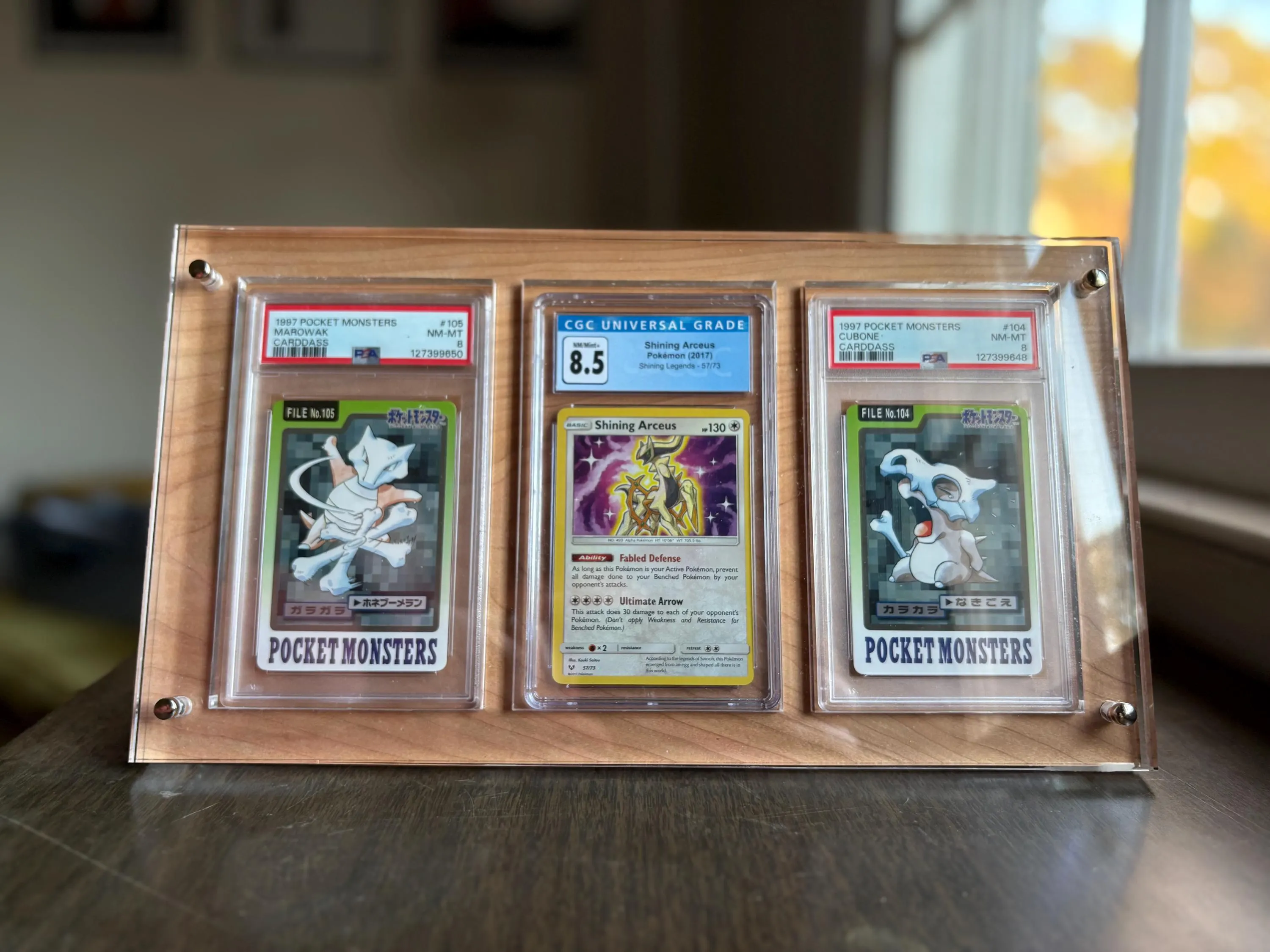
The desk tier — three slabs on a solid-wood-base magnetic stand — handles the daily rotation: the card of the month, the new return from PSA, the one a friend asked about. What was a nine-box closet became a three-zone architecture: archive cases in the closet, racks on the wall and shelf, stand on the desk.
The Before and After Data
The measurable results of the transition, tracked across the first six months.

The chart's four bars tell the whole story. Retrieval time fell from eight minutes to under thirty seconds. The share of the collection visible at a glance rose from five percent to ninety. Dust exposure — the annual lint-and-wipe index — fell by roughly 97 percent, because sealed enclosures and racked display don't admit the ambient dust that cardboard invites. New damage incidents — the corner dings and toploader scratches that accumulate in box life — went to zero. And the metric nobody puts on a spreadsheet but everyone feels: cards enjoyed monthly rose fivefold, from the thirty he used to touch to over a hundred, because a displayed collection is a used collection and a boxed collection is a stored one.
Market Analysis: The Box-to-Display Upgrade Wave
This case study isn't an outlier — it's a market segment measured in the millions. The graded card market reached $15.2 billion in 2026, up from $2.1 billion in 2020, and 2025 set an all-time grading record of 26.8 million cards processed. Every one of those slabs began its graded life in the box phase; the transition this collector made is the transition the market is making at scale, which is precisely why the display rack and case category has grown from a specialty niche into a stocked commodity across every major marketplace.

The economics of the transition have compressed as the category matured. A complete box-to-KAAPAI-rack upgrade — one sealed archive case, one wall rack, one free-standing rack, one desk stand, sleeves throughout — runs roughly $200 to $400, which in 2026 terms is less than the grading fees on the batch that fills the first rack. The upgrade decision has quietly inverted: it no longer costs money to leave cardboard, it costs money to stay.
User Analysis: Who's Still in the Box Phase
The box-phase collector base splits into four personas, and each exits to racks for a different reason.
The invisible collector — the profile in this case study — owns two hundred slabs he's stopped seeing. His trigger is rediscovery: opening a box after months and finding dust and yellowed edges. He exits via the full four-phase playbook.
The space-stressed collector has outgrown the closet. Her trigger is capacity, and she exits selectively: archive cases for density, racks only for the display tier, keeping boxes only for raw bulk where they still legitimately belong.
The security collector stores value, not cards. His trigger is insurance documentation and the realization that cardboard's fire and theft posture is a filing cabinet's, not a vault's. He exits toward locked cases first, racks second.
The host collector just wants the wall to look like something. Her trigger is aesthetic, and she exits fastest — straight to wall racks and desk stands, with the box question solved later.
Operational Structure Analysis: How the Supply Side Serves the Transition
The manufacturers serving this transition run a two-channel operation that explains the upgrade's affordability. Direct-to-consumer storefronts carry the spec-first product pages — UV percentages, slab-fit charts, magnetic hardware details — while marketplace channels carry the same hardware at commodity prices for buyers still comparison-shopping. The guidance layer has professionalized in parallel: the education content that teaches box users why cardboard fails — moisture absorption, no UV defense, dust admission, crush vulnerability — is itself a conversion channel, and the smartest brands publish it freely because the box-phase collector's first search is always "how should I store graded cards," never "which display case should I buy." The funnel begins at the failure the collector just discovered.
Upgrade Iteration Data: The Five Stages of Storage Maturity
The collector's journey maps onto a maturity curve the market has traced thousands of times.

Stage one, the shoebox era: everything together, nothing protected, protection score near zero. Stage two, cardboard boxes: organization arrives, protection barely moves — the case study's starting point. Stage three, plastic bins and binders: dust and moisture solved for raw stock, but slabs remain invisible. Stage four, slab binders and one-touches: graded stock gets browsability. Stage five — the destination, and where this collector landed — racked and case-based display: protection scores in the high nineties and visibility scores finally matching the collection's size. The curve's lesson is that the jump from stage four to five is the cheapest per-point gain on the entire path, because the infrastructure from stage four carries over and only the display layer is new.
Conclusion
The cardboard box era ends the same way for every collector who stays in the hobby long enough: with a closet full of value nobody can see and an inbox full of grading confirmations nobody's enjoying. The transition this case study documents — audit, triage, rehouse, display — takes one weekend and roughly the cost of a grading batch, and the return arrives immediately in retrieval seconds, dust-free enclosures, and a collection that finally behaves like one. The nine boxes are gone. The 180 slabs are on KAAPAI racks, behind UV-filtering acrylic, lit by LEDs, and touched weekly instead of yearly. The closet still holds storage — for the archive tier, where sealed cases do the quiet work — but the collection lives on the wall now, where a collection belongs. Cardboard stores cards. KAAPAI racks collect them.





