

Slab storage in a small space is the defining storage challenge of the modern grading boom: tens of millions of new graded cards enter the hobby every year, and a growing share of the collectors holding them live in apartments, rented offices, dorms, and studios where every square foot is negotiated. The good news is that small spaces force the design decisions that make slab storage systems better — vertical placement, dual-purpose furniture, high-density footprints — and the product market has spent three years engineering specifically for this buyer. This guide covers the ideas, the products, and the data behind space-saving slab storage for collectors who don't have a dedicated card room.
The Small-Space Reality: Vertical Space Is Free Space
The first principle of small-space slab storage is that floor space is scarce and wall space is not. Storage guidance aimed at apartment collectors is consistent on the point: most collectors run out of desk and shelf space long before they run out of cards, while walls offer effectively unlimited vertical real estate — a single 48-inch floating shelf holds fifteen to twenty graded slabs, and a multi-slab wall case showcases thirty to fifty cards in a footprint smaller than a poster frame.
The density math tells the same story from the other direction. Under-bed bins and closet systems pack the most slabs per square foot because they occupy space that apartments already have but rarely use for anything else — storage guides flag under-bed bins as an underused option for exactly this reason, especially for cards that don't need daily access.

The density chart makes the hierarchy visible: drawer-catalog systems and under-bed bins win on raw slabs-per-square-foot, while wall formats trade density for visibility — the apartment collector's real currency. The smart system uses the dense formats for the archive tier and the visible formats for the display tier, which is exactly the two-layer architecture the rest of this guide builds.
Idea One: The Archive Tier — Hidden Density
The archive tier holds the ninety percent of a collection that doesn't display, and in a small space it should be invisible. Under-bed bins with locking lids hold dozens of foam cases or zip binders flat in the dead zone beneath a bed — the single most underused footprint in any apartment. Closet shelf systems take the same logic upward: a converted closet with two shelves of long boxes or card bins can swallow a three-hundred-slab collection in a space that was previously storing winter coats. Collector forums from apartment veterans describe exactly this evolution — binders that look like photo albums on a shelf, higher-value cards in attractive DVD-style boxes that read as decor rather than storage, and ottoman storage praised as a genuine discovery.
For the raw and bulk side of a collection, stackable card bins have become the small-space standard — BCW's collectible card bins hold sixteen hundred to thirty-two hundred cards in footprint-friendly rows that also accommodate magnetics and toploaders, with hinged locking lids, recessed carry handles, and stackability that turns a closet floor into a warehouse.
Idea Two: The Combo Box — Display and Storage in One Footprint
The category most small-space collectors don't know exists until they see one: the combo display-and-storage case. The defining product — the Slab Station model — displays six slabs on the front face while storing roughly twenty-five more inside the same box behind them, which changes the behavior entirely: instead of picking six cards forever, you rotate. New grades come back from a submission, they go in the box; a card gets hot, it moves to the front. Everything stays in one footprint on one shelf, and the overflow is protected from dust and stacking damage instead of living in a separate closet box you never open.
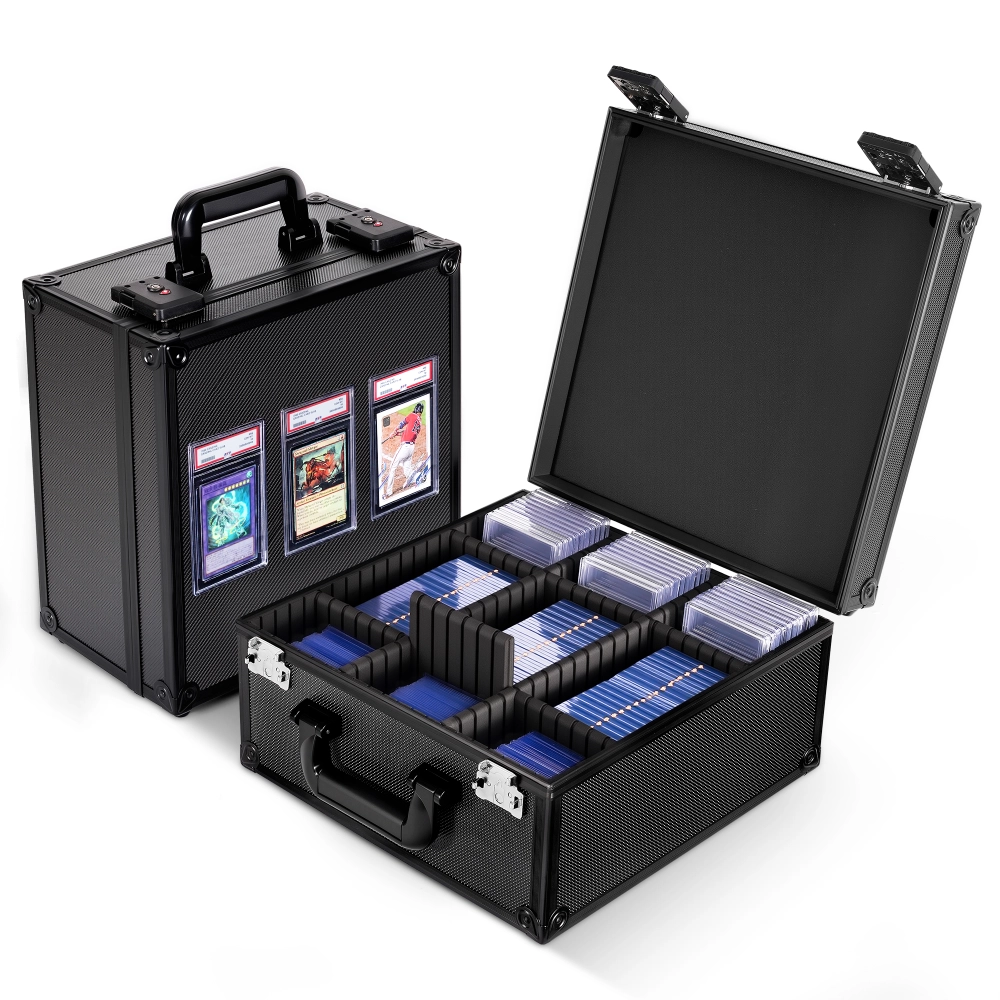
The Kabinka-style case above — carbon-fiber shell, TSA combination lock, six EVA-divided rows, and a display window showing the front slabs — represents the travel-friendly evolution of the combo category: archive density inside, gallery face outside, and a handle for collectors who move between apartments more often than they'd like.
Idea Three: The Wall Tier — Zero Floor Footprint
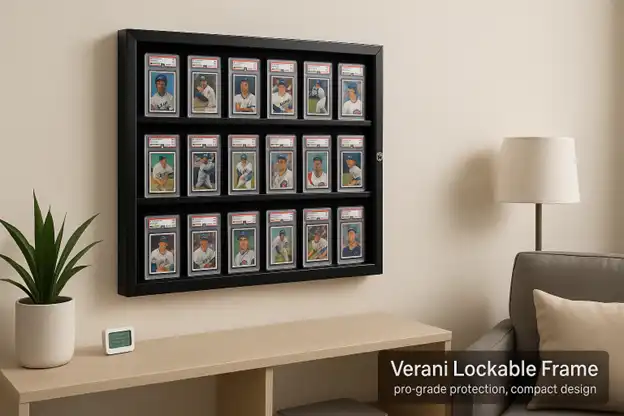
For the display tier, the wall is the entire strategy. Three formats dominate the small-space market. Lockable wall frames — like the Verani-style unit below a desk — hold twenty to thirty-five slabs behind a UV-rated acrylic door with a key lock, at eye level, in the footprint of a piece of art.
Floating shelves are the renter-friendly middle ground — slim ledges that hold three to six slabs each, hung with picture strips on a cleaned wall, layered so cards lean in overlapping rows. The 2026 buying guidance pairs them with museum putty behind every slab and one non-negotiable homework assignment: map the afternoon sun in the room before you drill, because walls catch the direct sunlight that fades cards even inside their holders.
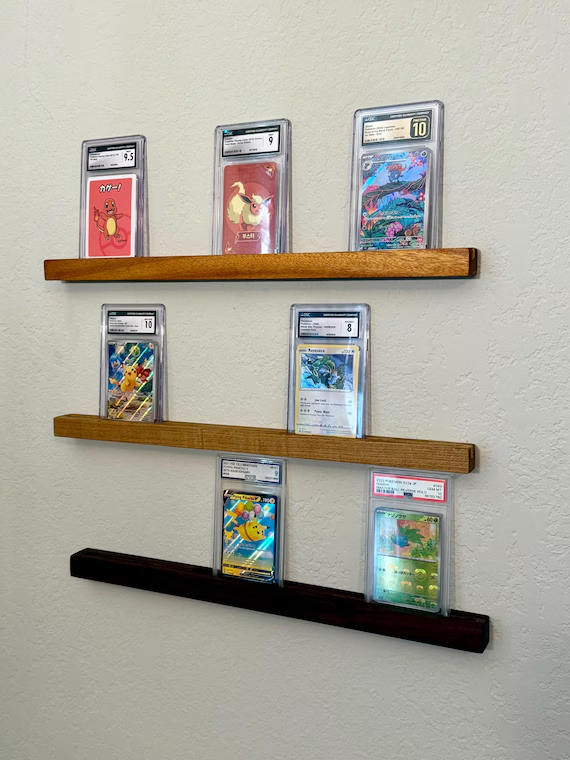
The triple floating-shelf arrangement above — three slim ledges carrying seven slabs across a hallway-width wall — is the archetypal apartment display: total floor footprint of zero, total visual impact of a gallery, and a swap time measured in seconds per slab.
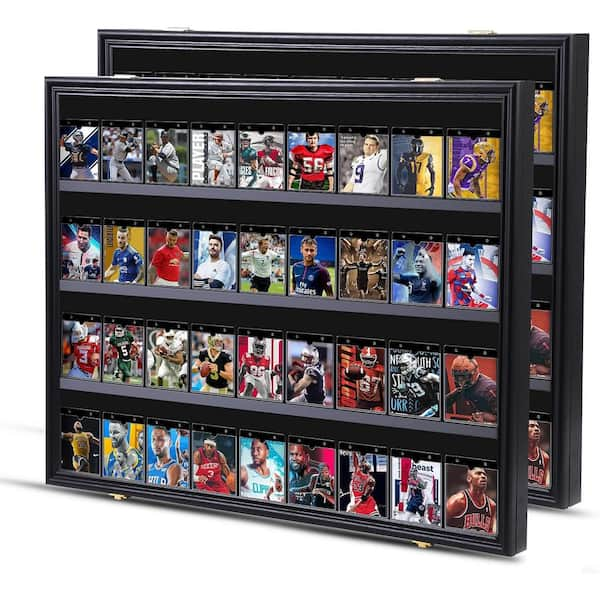
For collectors who need serious capacity from the wall, multi-row horizontal frames push fifty-plus slabs into a single framed unit — the densest visible format in the category.
Idea Four: The Drawer Catalog — Furniture That Eats Slabs
The newest entry in the small-space arsenal is the card-catalog drawer unit: BCW's six-drawer graded card catalog holds roughly forty-three slabs per drawer — 258 total, or 126 with bumpers — in a footprint engineered to fit standard cube-shelf configurations, with interlocking units that stack and expand, safety stops, label slots, and acid-free construction. It's the format that converts a two-foot shelf into a two-hundred-fifty-slab archive while looking like furniture.
Product Market Analysis: A Category Re-Architected for Small Spaces
The market data explains why every format above exists. The graded card market reached roughly $15.2 billion in 2026, up from $2.1 billion in 2020, and grading volume set an all-time record of 26.8 million cards in 2025 — a 32 percent year-over-year increase. Every one of those slabs needs a home, and the buyer demographic has skewed younger and more urban as TCGs overtook sports in submission volume, pulling the display-case category toward the apartment market.

The category's response has been measurable: the 2026 product landscape now prices a complete small-space system from $20 under-bed bins to $180 drawer catalogs, with wall frames and combo boxes filling the $60–$150 middle — meaning a collector can deploy a full two-tier archive-plus-display architecture for less than the cost of a single grading submission batch. Wall-mounted versus desktop is now an explicit product axis, with manufacturers publishing comparison tables on space efficiency, capacity, accessibility, and UV risk because buyers have learned to ask.
User Analysis: Four Small-Space Buyer Personas
The apartment and small-office buyer base splits into four personas, and each deploys the formats above differently.
The renter-collector leases, moves every year or two, and can't drill. This persona buys under-bed bins for the archive, floating shelves hung with adhesive strips for display, and a combo box as the bridge — and the forum wisdom applies: attractive boxes and album-style binders chosen to look like decor, plus collectible insurance, which veterans note is literally cheaper than safe-deposit-box options near them and buys the peace of mind that drilling was going to.
The small-office professional keeps a curated display at work — five to fifteen slabs on a desk stand or one lockable wall frame behind the desk — where the combo box's six-front/25-inside ratio solves the desk-footprint problem exactly, and the capacity guidance confirms the tier: five to fifteen slabs means tiered stands or a combo box; fifty-plus means combo boxes plus closed storage.
The dorm and budget collector optimizes per dollar and per cubic foot simultaneously: one zip binder for the working collection, one card bin under the bed, zero display — the system that scales directly into the apartment configuration later without replacing anything.
The downsizing veteran is the fastest-growing persona — collectors leaving houses for condos and apartments who need to compress three bookshelves of slabs into one closet and one wall, and who drive the drawer-catalog and multi-row wall-frame sales.
Operational Structure Analysis: How the Market Serves Small Spaces
The supply side has reorganized around this buyer in three visible ways. First, the retail layer has bifurcated into marketplace volume — Amazon, Target, and Home Depot stocking card bins, wall frames, and drawer units as commodity storage — and direct-to-consumer specialty brands publishing spec-first product pages, with the comparison content itself becoming a purchase channel. Second, the design layer has converged on dual-purpose engineering: display cases that store, storage boxes that display, and drawer units that fit cube shelving — the industry's answer to the apartment's central constraint that no single object may do only one job. Third, the guidance layer has professionalized, with manufacturers now publishing room-mapping advice, wall-versus-desktop decision tables, and weight-load calculations as standard content, effectively educating the buyer into higher-spec purchases.
Upgrade Iteration Data: The Product Ladder
The category's iteration history is a direct record of the apartment market's maturation.

Tier one, the legacy era: flat cardboard boxes and shoeboxes — maximum density, zero accessibility, the format that made cards invisible. Tier two: zip binders and toploader binders, which added browsability at apartment-friendly prices. Tier three, the 2024–2025 breakthrough: the combo display-and-storage box, which solved the two-job problem in a single footprint and created the rotation habit as a product feature. Tier four: lockable wall frames with published UV ratings and floating-shelf ecosystems built around damage-free mounting. Tier five, 2026: drawer catalogs that interlock into furniture, compact LED-integrated cases, and gasket-sealed wall cabinets — the point where a small-space collector can assemble a system indistinguishable in function from a dedicated card room's, at one-tenth the footprint. Each tier absorbed the previous one's jobs while adding the one the apartment market demanded next: visibility, security, spec transparency, and density, in that order.
The Deployment Blueprint
The practical assembly, by collection size. Under fifteen slabs: one combo box and one floating shelf — display six, store the rest, zero floor space. Fifteen to fifty: combo box for the rotation tier, under-bed bins or a drawer catalog for the archive, one lockable wall frame as the anchor display. Fifty-plus and growing: drawer catalog interlocked into cube shelving, wall frames or multi-row horizontal frames for the display wall, card bins for raw bulk, and the quarterly rotation rhythm moving slabs between display and dark. Every tier of the blueprint shares the small-space commandments: vertical over horizontal, dual-purpose over single-purpose, opaque darkness for the archive, published UV ratings for anything lit, and museum putty behind anything leaning.
Conclusion
The apartment collector of 2026 holds an advantage the house collector doesn't: a product market that has spent three years engineering specifically for constraint. Slab storage no longer requires space — it requires the right five objects arranged vertically, and the discipline to keep the archive dark, the display rotated, and the system documented. Under-bed bins swallow the archive; combo boxes turn one shelf into a gallery with a twenty-five-slab back room; drawer catalogs convert cube shelving into a two-hundred-fifty-slab vault; wall frames turn dead drywall into a museum. The grading boom will keep producing slabs, and the apartments will keep getting collected in — but with the system above, the two facts stop competing. Small space, serious collection: slab storage solved.





