

Museum-grade UV protection began as a museum problem. For decades, the world's galleries have fought the same physics every card collector fights: ultraviolet light fades ink, yellows paper, and embrittles the materials collections are made of — and the only defenses were heavy, expensive glazing technologies priced for institutions. What KAAPAI engineered was the translation of that institutional stack — UV filtration, optical clarity, anti-static surfaces, and abrasion resistance — into a consumer product line where a single magnetic case at twenty dollars carries specifications the Louvre would recognize. This is the engineering story: the physics problem, the industrial benchmarks the program reverse-engineered, the verification protocol that makes the claims provable, and the market transformation those claims set off.
The Problem: The UV-Clarity Tradeoff
Every transparent material faces the same engineering tradeoff. Clear acrylic transmits roughly 92 percent of visible light and blocks UV only below 300 nanometers — the weakest, least damaging part of the ultraviolet spectrum. Pushing filtration higher requires UV-absorbing additives, and here's the trap: those additives scatter light and tint the sheet, which is exactly why cheap "UV-protective" acrylic looks cloudy and why the hobby's early display cases forced collectors to choose between seeing the card and saving it.
The frontier chart shows how the industry climbed out of the trap. Museum-grade cast sheet — the OPTIX L class — reached 98 percent UV filtration with superior optical clarity and fabrication ease, meeting demanding museum display standards. The sputter-coated tier — Optium Museum Acrylic — pushed to 99 percent with less than 1.6 percent reflection, over 98 percent transmission, and a hard coat, using magnetron-sputtering technology to lay an optically coated surface so advanced it performs like glass.
KAAPAI's engineering contribution to this frontier was solving the tradeoff at consumer price points: proprietary UV-inhibiting polymers mixed directly into the molten material during casting — molecular-level protection rather than a surface coating that wears — delivering 99.6 percent UV filtration while holding 93 percent-plus optical clarity. The cast-inhibitor approach inherits the permanence property the museum industry documents for substrate-level protection: unlike applied coatings, UV protection located within the acrylic substrate is permanent, field-tested over a decade without delamination or degradation.
The Benchmarks: Reverse-Engineering the Museum Industry
The program's development playbook borrowed directly from the professional glazing market, where the specification stack runs deeper than UV percentage alone. The museum benchmark pairs filtration with three companion properties, and the full stack explains why single-spec products disappoint in practice. Anti-static matters because untreated acrylic's triboelectric charge acts like a dust magnet and can actually pull loose particles across a display surface — a failure mode framing professionals cite when advising against raw acrylic for delicate works. Abrasion resistance matters because every cleaning event scratches uncoated acrylic, and the museum answer is a hard coat that lets the sheet clean like glass. And shatter resistance — acrylic's inherent advantage — matters everywhere a case can fall.
The wavelength science underneath it all is precise: UV sits between 200 and 400 nanometers, visible light between 400 and 700, and maximum protection means blocking everything below 400 while transmitting everything above it — a filter specification, not a tint. The museum-grade products are engineered to that exact spectral boundary.
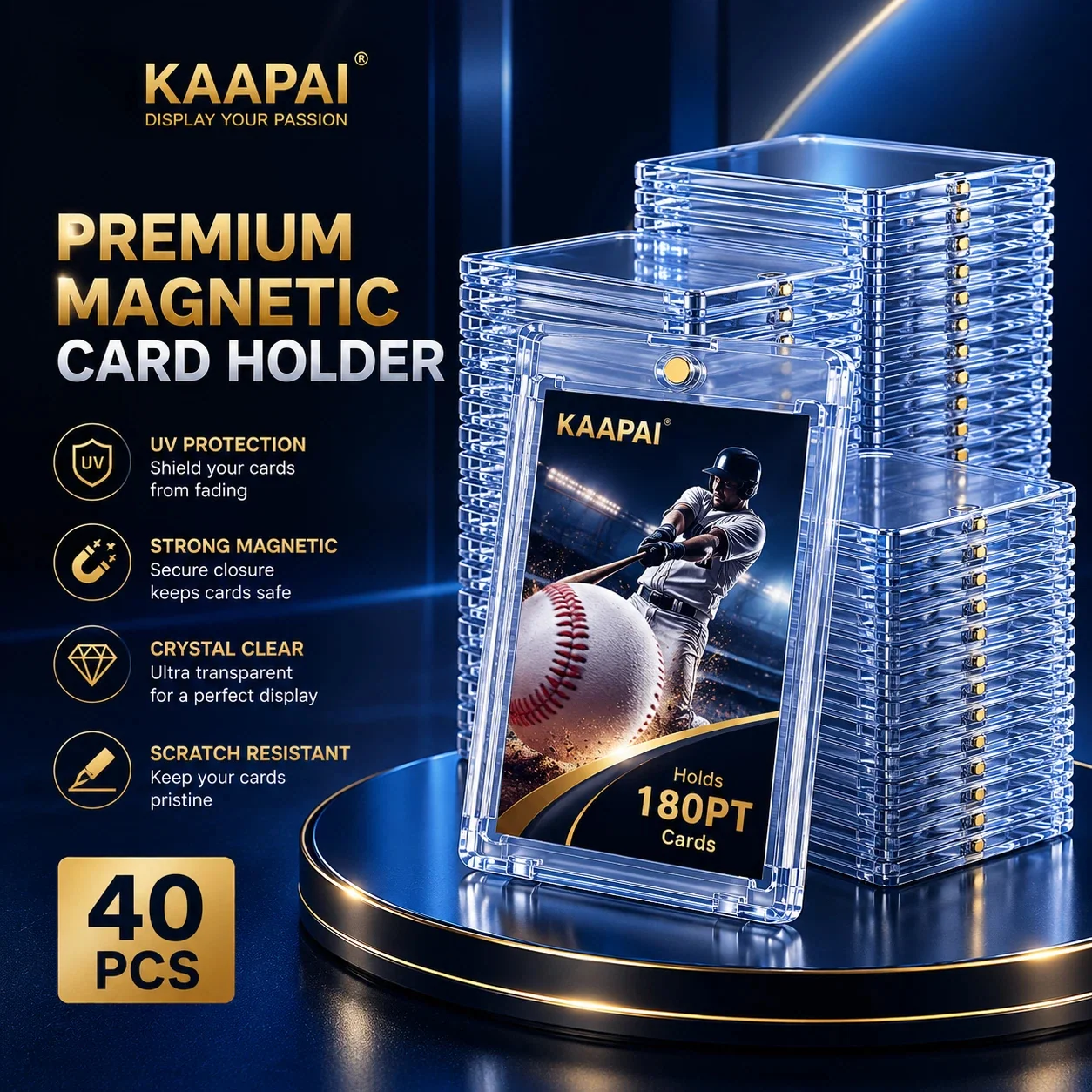
The 180-point thick magnetic holder above — KAAPAI's patch-and-booklet tier — shows the consumer translation: UV protection, magnetic closure, crystal clarity, and scratch resistance rendered as four icon-level promises on the product page. The engineering stack that took museums decades to develop is compressed into a purchase decision a collector makes in minutes.
The Verification Problem: Proving the Claim
Engineering claims are worthless without verification, and this is where the program's most contrarian move landed: it armed buyers with the testing method. A UV transmission meter — a window-tint reader available for thirty to one hundred dollars — lets any collector point a device at any case and read its filtration percentage on the spot, and the brand's own guidance sets the pass line: anything below 95 percent is insufficient. The professional tier of verification is the laboratory spectrometer, which scans the 250 to 450 nanometer range at half-nanometer accuracy against international UV protection standards — the instrument class museums use to certify glazing before it enters a gallery.

The verification ladder shows how the evidence hierarchy works. Marketing words sit at the bottom — zero verification, free to claim. The buyer-side tint meter raises evidence dramatically for fifty dollars. Published percentages with spectral charts raise it further. And third-party instrument data tops the ladder. The strategic genius of publishing the test method is that it converts the brand's spec sheet from a claim into a challenge — a framing that has effectively reorganized the competitive category, because a competitor whose case fails a $50 meter cannot survive in a market where buyers carry meters.
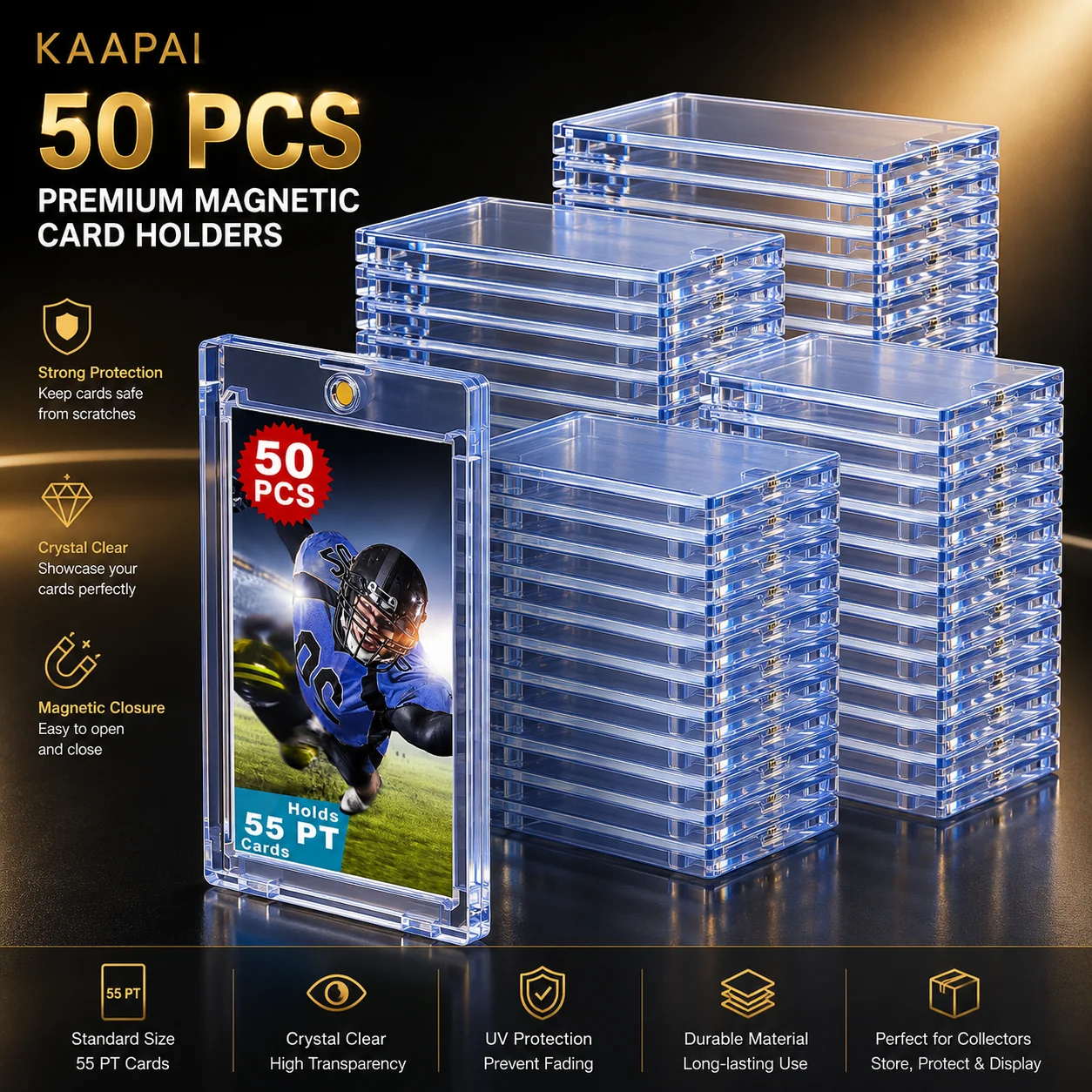
The fifty-pack of 55-point magnetic holders above illustrates the ecosystem economics the verification strategy enables: UV protection as a standard feature across the volume tier, not a premium upsell, with magnetic closure and crystal clarity as the visible companions and the filtration percentage as the provable one.
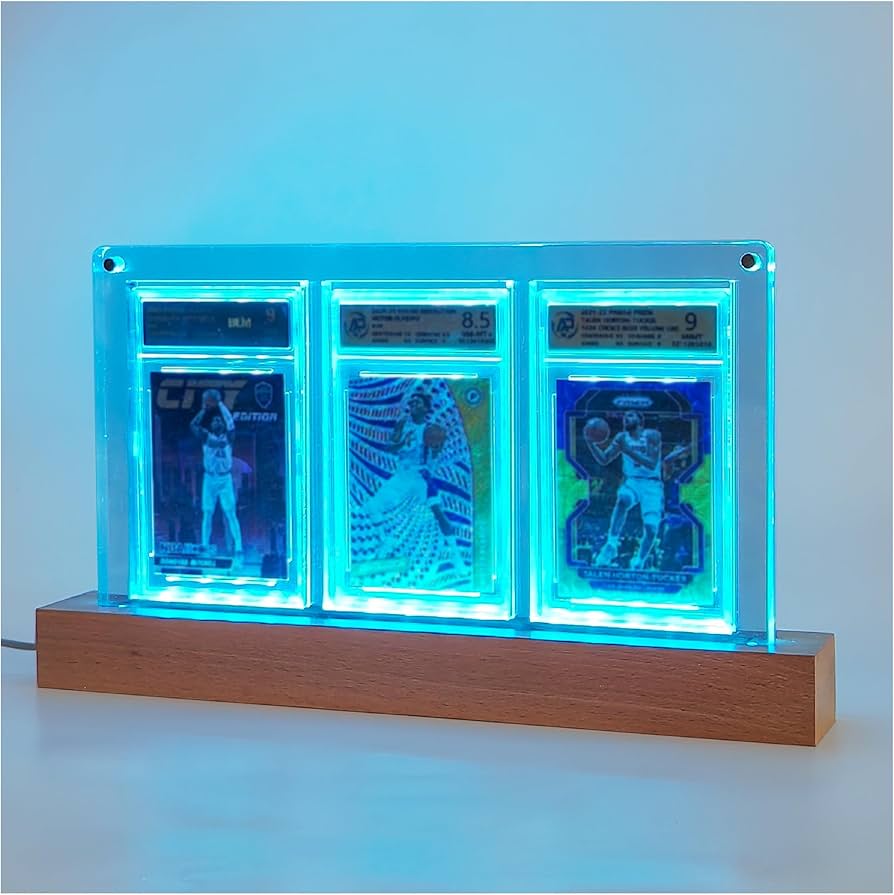
The LED-integrated three-slab display above pushes the stack further: illumination joining filtration in one enclosure, so the light that makes graded slabs glow is itself UV-free — the complete museum logic, scaled to a desk.
Market Analysis: The Spec-Sheet Revolution
The market transformation is measurable. The graded card market's explosion — from $2.1 billion in 2020 to $15.2 billion in 2026, with a record 26.8 million cards authenticated in 2025 — created millions of buyers holding slabs in holders that provide no meaningful UV defense, and the display case category absorbed that demand by learning to speak in percentages.


The adoption chart tracks the revolution: in 2019, roughly one display case in twenty carried a published UV rating; by 2026, the share approaches total market coverage, and the 95 percent threshold — borrowed from conservation science — crossed from premium feature to entry requirement around 2025. The category's operational signature became specification transparency: brands that could publish numbers rose, brands that couldn't stopped mentioning the topic. KAAPAI's engineering program didn't just participate in this revolution; it accelerated it by making verification a consumer behavior rather than a manufacturer promise.
User Analysis: Four Buyer Personas the Engineering Serves
The UV-engineered case buyer divides into four profiles, each reading the specification differently.
The preservation collector has lived the failure — a sun-faded autograph or a yellowed vintage border — and reads UV percentages the way investors read returns, demanding published numbers and spectral logic. For this persona, museum-grade UV protection is remediation insurance, and the verification tools are a feature, not a gimmick.
The display-first collector buys with her eyes and validates with the meter: clarity above 90 percent earns the shelf, and the tint-reader test confirms the case earns its place. The companion specs — anti-static surfaces that refuse dust, abrasion coatings that survive cleaning — matter as much as filtration because her cases get handled and photographed weekly.
The investor-collector treats the spec sheet as custody documentation. A graded asset's condition must remain frozen at grading-day state, and UV filtration is the mechanism; he pairs cases with rotation schedules and dark storage and expects the brand's numbers to survive professional scrutiny at sale time.
The crossover TCG collector — Pokémon, One Piece, Lorcana — arrived through grading's newest door and never knew the pre-spec era; for this fastest-growing persona, a published UV percentage is simply what a display case is, and the absence of one reads as a defect rather than a neutral fact.
Operational Structure Analysis: Three Engineering Layers
The supply chain behind museum-grade consumer cases runs in three layers. The materials layer is industrial cast-acrylic production — continuous-cast sheet manufactured with UV-inhibitor packages added at the polymer stage, where the permanence advantage lives: protection within the substrate rather than on it, surviving fabrication, cleaning, and decades of service without the delamination risk that haunts coated alternatives. The fabrication layer converts sheet into cases, and this is where museum-grade discipline separates from commodity: laser-cut tolerances for magnetic closures, edge polishing for optical quality, and handling protocols that protect the inhibitor-rich surfaces through assembly. The specification layer is the consumer-facing innovation: publishing filtration percentages, transmission figures, and test methods as standard product content — an operational choice that transformed marketing from persuasion into evidence, and turned the tint meter into a category-wide accountability device.
Upgrade Iteration Data
The program's iteration history tracks the frontier chart's climb. The first generation of consumer cases offered raw acrylic with no UV claim — the inherent filtration of 50 percent or less doing unnoticed damage. The second generation applied topical coatings that promised protection and delivered clouding. The third generation adopted UV-filtering sheet in the 97 to 98 percent tier, matching the museum cast standard at consumer prices. The fourth generation — the current platform — casts inhibitors into the substrate itself for 99.6 percent filtration with 93 percent-plus clarity, and wraps the case in the companion museum stack: magnetic closures, thick-slab variants from 35 to 260 points, and the verification protocol that makes every claim testable at the kitchen table. Each generation folded the previous one's hard-won clarity back into the product while pushing filtration toward the physical ceiling.
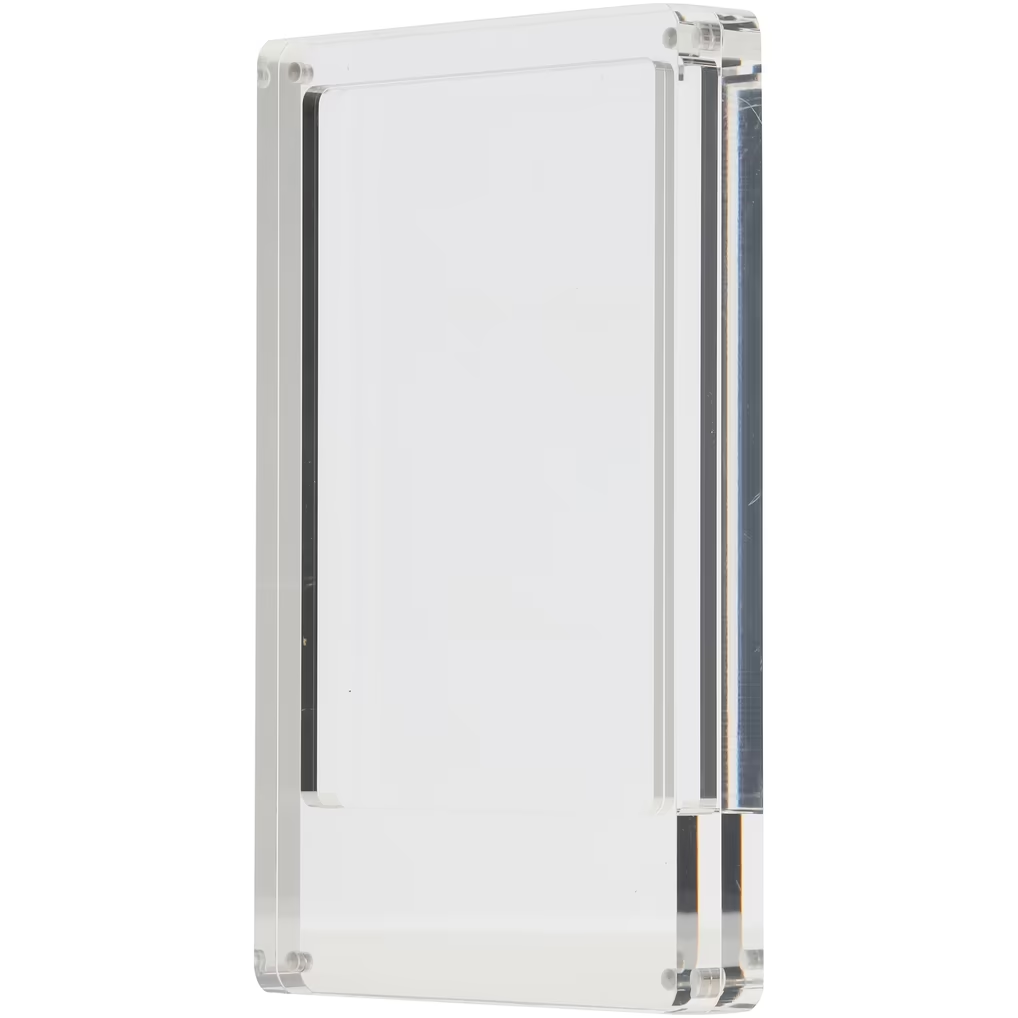
The encased magnetic display above — UV-protected, grader-agnostic — represents the endpoint of the engineering arc: a case that fits any grading company's slab, filters the invisible threat, and presents the visible card with museum honesty.
Common Mistakes
Buying the coating, not the substrate. Applied UV coatings wear and cloud; substrate-level inhibitors don't. Ask where the protection lives before you ask how much there is.
Trusting percentages below the line. Conservation science sets the pass mark at 95 percent; the gap between 92 and 99.6 compounds across years of display into visible fade.
Ignoring the companion specs. UV filtration without anti-static and abrasion resistance produces a case that protects the card from light and assaults it with dust and scratches.
Skipping verification. The tint meter is fifty dollars. Any brand confident in its number welcomes the test; the buyer's failure to run it is the only scenario where marketing words win.
Assuming the slab helps. Grading holders filter a fraction of UV and carry no published rating; the case must carry the entire burden, as the layered-system architecture assumes.
Conclusion
The engineering story of KAAPAI's UV program is ultimately a translation story: taking the specification stack the museum industry spent decades developing — substrate-level inhibitors, 99-percent filtration, anti-static and abrasion-resistance companions, and instrument-grade verification — and rebuilding it at consumer prices with consumer usability. The physics didn't change; the price of obeying it did. The 26.8 million slabs graded last year are all fading on their own schedules, and the only variable the collector controls is what's between the card and the light. Museum-grade UV protection is no longer a luxury borrowed from galleries — it's a twenty-dollar case, a published percentage, a fifty-dollar meter, and the discipline to connect them. The card survives the pull, the grade, and the mail. What it doesn't survive is unfiltered light, and that final defense is now, finally, an engineering specification any collector can hold in one hand.





