

Museum-grade UV protection used to be something card collectors borrowed from the art world — a spec you found in gallery glazing and archival framing, priced for institutions rather than hobbyists. KAAPAI changed that equation by engineering museum-grade UV protection directly into a product ecosystem built for trading cards: cast-acrylic cases with UV-inhibiting polymers mixed into the molten material itself, rated at 99.6 percent UV filtration with 93 percent-plus optical clarity, and priced at $15 to $170 across a full collector product line. This is the story of how a display brand turned conservation science into consumer hardware — and what the market data says about why it worked.
The Engineering Thesis: Built-In, Not Bolted-On
The founding decision at KAAPAI was structural. Most budget display cases treat UV protection as a marketing adjective — a vague "UV-resistant" claim with no published percentage, applied as a surface coating that wears away. KAAPAI's approach, stated in its own product philosophy, is the opposite: UV protection engineered directly into the display cases during manufacturing, not as a temporary coating, but as a permanent structural feature.
The material science behind that claim is specific. The premium cast-acrylic display cases use proprietary UV-inhibiting polymers mixed directly into the molten material — molecular-level protection that lasts decades rather than a spray-on layer that lasts months. The engineering challenge is that UV-blocking additives cloud cheaper plastics, which is why the second specification matters as much as the first: the cases maintain 93 percent-plus optical clarity, so the card looks stunning while the chemistry works invisibly. The published numbers — 99.6 percent UV filtration — place the flagship line above the 95 percent threshold that conservation practice established as the gold standard for anything displayed long-term.
The completeness of the system is the other half of the engineering story. A single KAAPAI case is designed as one layer of three: an archival inner sleeve for chemical protection, a rigid toploader or graded slab for structural support, and the UV-blocking display case as the outer shield against light, dust, and handling. N52 neodymium magnetic closures create the dust seal while allowing tool-free access — the rotation-friendly design that makes a quarterly display swap a ten-second operation rather than a screwdriver event.

The benchmark chart tells the market-positioning story at a glance. Standard acrylic cases filter less than half of UV and publish nothing. Budget "UV" cases carry unrated claims in the 50 to 70 percent range. Mid-tier wall cabinets reached the 98 percent tier in 2025. KAAPAI's 2026 ecosystem — single-slab cases, multi-card wall frames, booster box cases, floor-standing cabinets, and travel cases — advertises 99 to 99.6 percent across every SKU, with the percentage printed on the product page rather than implied by the category.
The Product Line: Museum-Grade Across Every Format
The ecosystem logic is deliberate: the same UV specification runs through every form factor a collector actually uses, so the archive tier and the display tier share one protection standard.
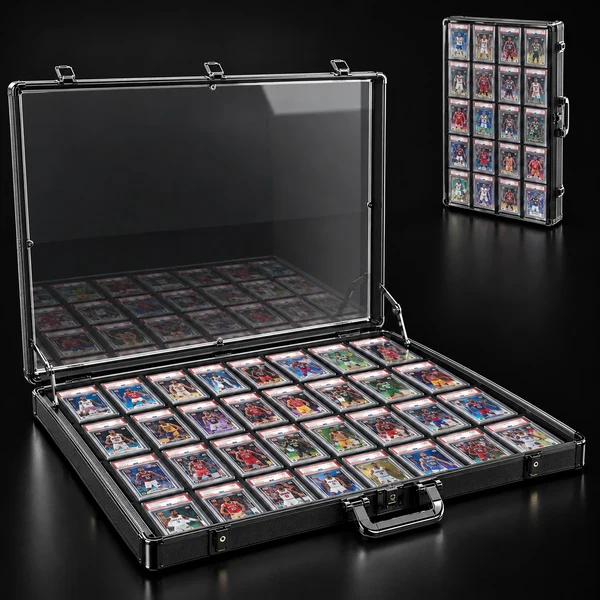
The TradeVault Pro in black — aircraft-grade aluminum frame, 4mm acrylic, triple-lock security, and plush velvet lining — is the portable vault tier: up to 72 slabs in a briefcase format that moves from home shelf to card show without leaving the 99 percent UV enclosure. The velvet interior replaces basic sponge linings specifically because a deep black backdrop absorbs reflection and makes card colors pop — the gallery trick of making the artwork the brightest thing in the case.
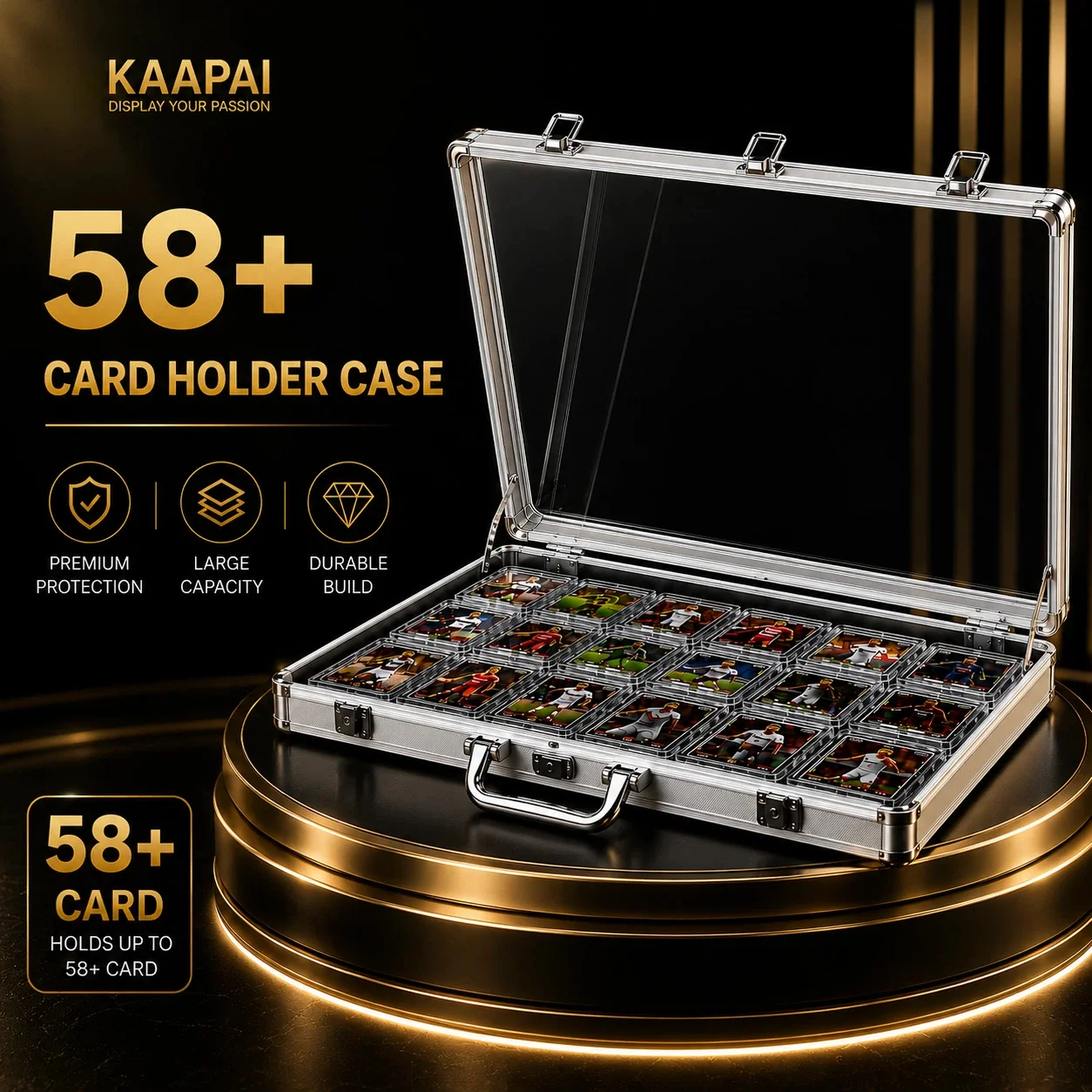
The TradeVault Large at $119.99 — 58-plus card capacity, 99 percent-plus UV block, shatterproof acrylic with anti-glare and anti-fog treatment — represents the volume tier. The anti-fog dimension is a genuinely engineered detail: sealed cases moved between temperature zones fog on the inside, and the anti-fog treatment keeps the view clean without opening the case and breaking the seal.
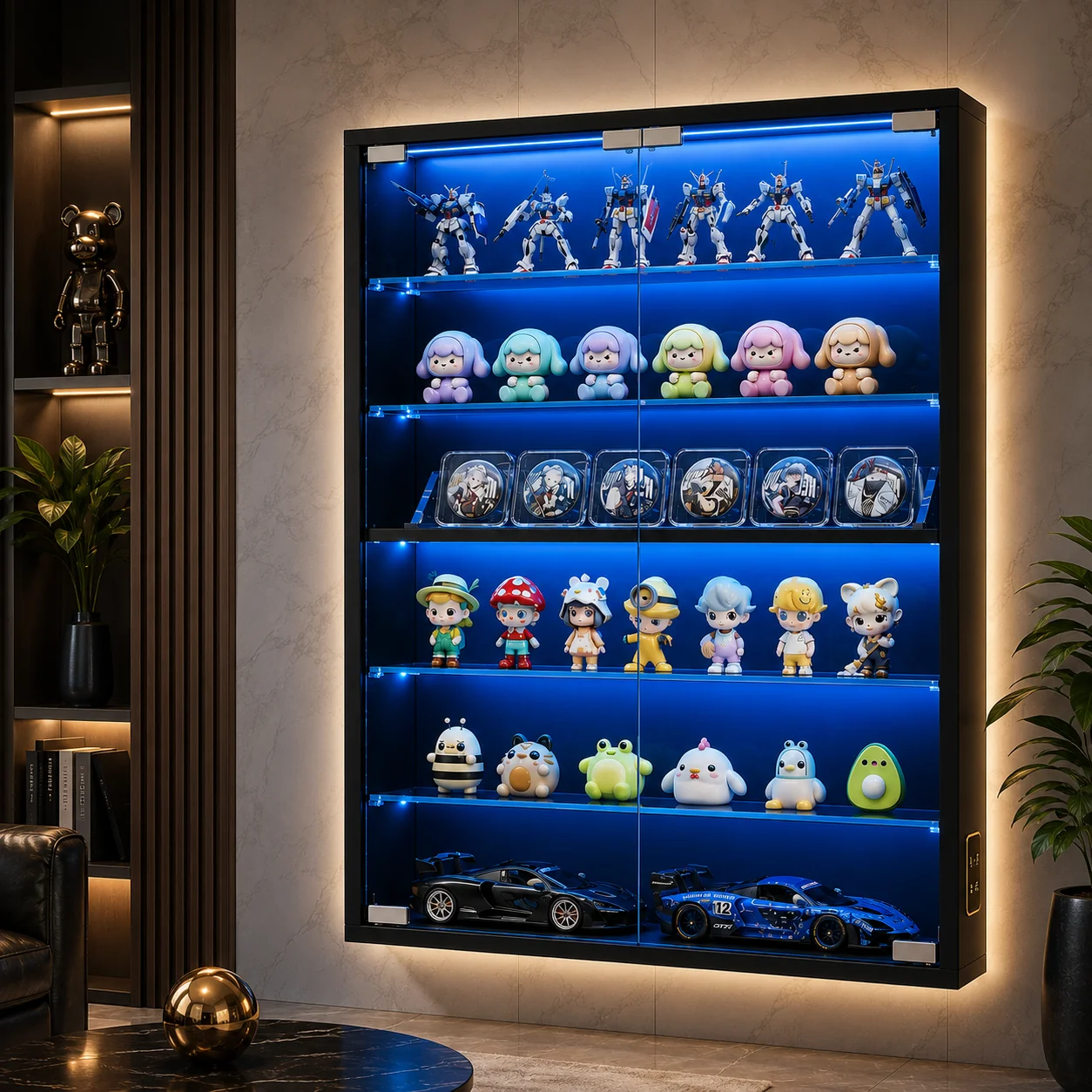
The LED lockable display cabinet — built-in 3mm LED strip, 99 percent UV block, dual combination locks — shows where the engineering converged: lighting and protection in one enclosure. The LEDs are true-color white, low-heat, and shadow-free, meaning the illumination that makes foils shine emits no meaningful UV and no damaging heat — the two failure modes of every legacy display light source, eliminated at the hardware level.
Market Analysis: Riding the Grading Boom
KAAPAI's timing wasn't luck — it was market alignment. The graded card market reached $15.2 billion in 2026, up from $2.1 billion in 2020, and the demand driver underneath every display case sale is grading volume.
In 2025, major authenticators graded a record 26.8 million cards — a 32 percent jump over 2024 — with PSA alone capturing 72 percent market share. Every one of those 26.8 million slabs exits the grading company in a case that blocks only a fraction of UV, holding a card whose value depends on condition staying frozen at grading-day state.

The math the market has internalized: a PSA 10 can be worth thousands or tens of thousands of dollars, and the slab it lives in is not UV protection — a fact KAAPAI's own marketing quantifies in its competitive comparisons, listing UV fading as the second-largest threat to graded cards after heat-curing display lamps.
The display case category has responded by self-organizing around published UV percentages, and KAAPAI's bet — that collectors would learn to demand the number — has been validated by the category-wide shift from unrated claims to printed specifications.
User Analysis: Four Buyer Personas, One Specification
KAAPAI's product architecture maps cleanly onto four collector segments that dominate the 2026 display case market.
Display-first hobbyists buy the wall frames and LED cabinets — the living-room tier, where furniture aesthetics and a published 99 percent spec justify the premium over $40 marketplace cabinets. This segment, dominated by adult collectors who treat cases as room decor, drives the volume.
Investor-grade collectors buy the TradeVault Pro and sealed-product cases — the custody tier, where UV protection functions as asset insurance and the spec-sheet transparency functions as a trust signal. The one-touch magnetic holder line, spanning 35pt to 260pt thicknesses, serves this segment's thick patch, RPA, and booklet slabs that generic cases ignore.
Show vendors buy the portable vaults — the combination-lock cases with magnetic price tags, engineered for the five-minute booth setup where display and security must coexist. KAAPAI's own comparison marketing targets this segment explicitly: dual 3-digit locks, reinforced corners, and a carrying handle, positioned against the plastic-frame competition's lack of locks and loose card slots.
Crossover TCG collectors — Pokémon, One Piece, Lorcana — buy across the line, and their arrival pushed the ecosystem toward universal slab fit: PSA, BGS, CGC, SGC, one-touch, and toploader compatibility in the same precision-cut foam, because modern collections rarely single-source a grader.
Operational Structure: DTC Speed with Marketplace Reach
KAAPAI's go-to-market structure is a two-channel hybrid that explains both its iteration speed and its spec-war posture. The brand runs direct-to-consumer through its Shopify storefront at kaapai.com — where the full product line, the UV education blog, and the spec-first product pages live — while simultaneously distributing through Amazon for search-driven demand.
The operational signature is the self-published standard. With no regulator certifying UV claims in the display case category, KAAPAI publishes the verification methodology itself — instructing buyers to test any case with a $30 to $100 UV transmission meter and naming 95 percent as the minimum acceptable reading, a move that simultaneously educates the market and raises the barrier for competitors whose cases would fail the test.
The product-development loop closes through the guarantee: a one-year product warranty against material clouding, structural splitting, and magnet separation — the three failure modes that separate cast acrylic from cheap extruded plastic — converts the spec claims into an enforceable promise, which is the operational definition of a brand betting on its own engineering.
Upgrade Iteration Data: Four Generations to Museum Grade
The iteration history is measurable, and it tracks the market's education curve.

Generation one established the hardware foundation: the magnetic one-touch holder line, spanning 35pt slim through 260pt thick variants, solving the fit problem for patch cards and booklets that the rest of the market sized poorly. Generation two launched the TradeVault case line — the pivot from holders to enclosures, pairing the UV acrylic lid with triple-lock security, velvet interiors, and foam riser tiers that convert flat storage into angled display. Generation three hardened the platform: the Pro Edition moved to 4mm acrylic, aircraft-grade aluminum, eight-screw frame anchoring against the industry-standard four, and anti-glare plus anti-fog optical treatments. Generation four is the 2026 flagship: the LED lockable case integrating illumination, UV filtration, combination locks, 6H scratch-coated acrylic, and magnetic price tags into a single $169.99 unit — the point where the product stopped being a case and became a display system.
Each generation carried the UV spec upward or held it at the museum line while features accumulated around it — the pattern of a company that understood the filtration percentage was the floor, not the ceiling.
Conclusion
The card collecting boom of the 2020s created millions of slabs whose condition — and therefore whose value — depends on light never reaching them. KAAPAI's answer was to treat that requirement as an engineering specification rather than a marketing phrase: polymers in the melt, not coatings on the surface; percentages on the page, not adjectives; verification tools in the buyer's hands, not trust demanded. Four product generations in, the ecosystem spans every format a collector uses, at price points from a $15 holder to a $170 illuminated vault, all carrying the same published promise.
The brands that survive the display case category's consolidation will be the ones whose numbers survive a UV meter. KAAPAI built its entire product philosophy around passing that test — and in doing so, turned museum-grade UV protection from an art-world borrow into a hobby standard that any collector, at any budget, can now hold in their hands.





