

UV radiation is invisible, cumulative, and — unlike the dust on your display cases — completely undetectable to your eyes until the damage it caused shows up as a faded autograph or a creamed border. That's why the question every serious collector eventually asks isn't "is my room safe?" but "how do I prove it?" The answer is a measurement protocol straight out of the museum world: two inexpensive instruments, a fifteen-minute survey, and a pass/fail number that takes the guesswork out of where your collection can live. This guide walks through the tools, the readings, the thresholds, and the market behind them — so your man cave can be a gallery instead of a slow-motion fade chamber.
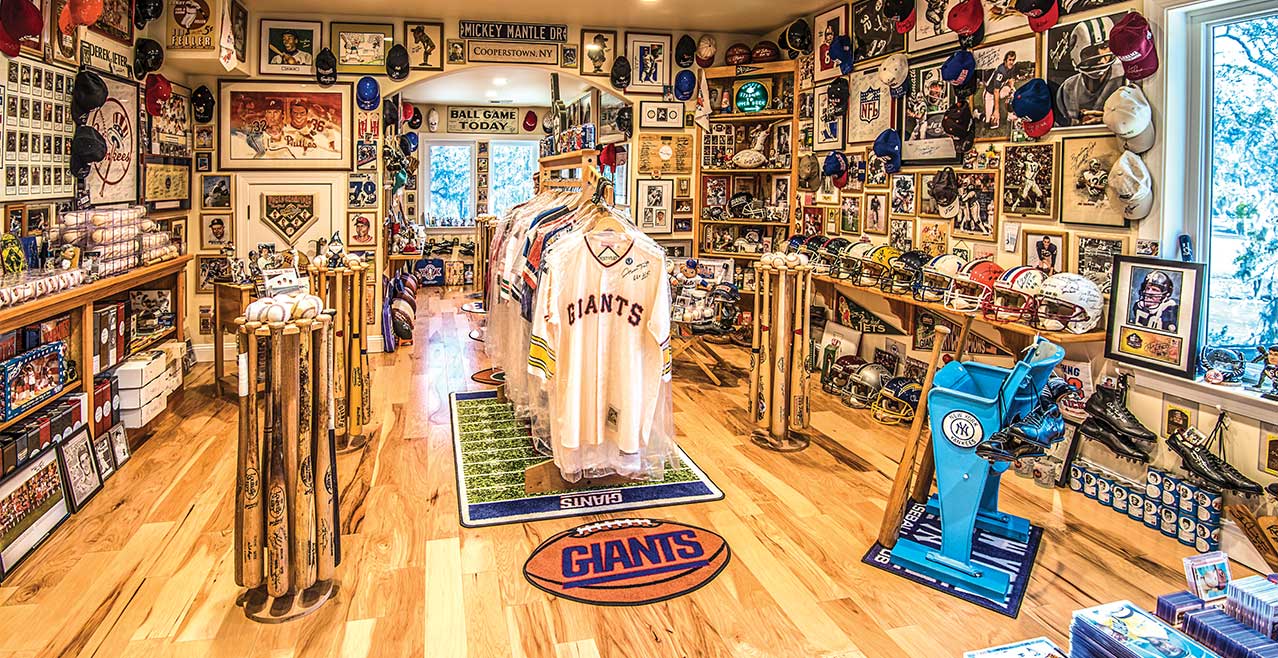
The room above is every collector's dream — and a conservator's diagnostic challenge. Every framed piece on those walls, every jersey under those lights, and every card in that room is being measured by photons right now. The memorabilia room's two big windows deliver daylight from morning to afternoon; the track and ambient fixtures deliver artificial light every evening; and without a single instrument reading, nobody in that room knows which surfaces are safe and which are on the fade clock. Measurement is what turns a room like this from a hope into a system.
The One Number That Governs Everything: 75 Microwatts per Lumen
Conservation science has already set the threshold, and it's refreshingly simple. Collections should never be exposed to UV in amounts exceeding 75 microwatts per lumen — the ratio of ultraviolet energy to visible light in a space — and any light source registering above that figure must be filtered or excluded. The same body of practice adds the operational rules that translate directly to a home collection: keep light levels as low as practical, expose materials to light only while in use, and store them light-tight when not in use.
That single ratio is why you can't judge a room by brightness alone. A sunny window and a dim interior wall can both read "fine" to your eyes while delivering wildly different UV doses — the window floods the space with ultraviolet that outruns its visible light, while a modern LED display wall delivers abundant visible light with almost no UV in it. The ratio is what separates those two realities, and measuring it requires the two-instrument toolkit the museum standard specifies.
The Toolkit: A Lux Meter and a UV Monitor
The Department of the Interior's Museum Property Handbook — the same standard federal collections are audited against — lays out the equipment protocol plainly. Light levels are measured with a light meter; ultraviolet is measured with a UV monitor; the two work as a pair. The light meter should be sensitive down to 25 to 50 lux with 10 percent or better accuracy, readings are taken with the sensor parallel to the object's surface for flat items like cards, shadows from hands and body are eliminated, and — the detail most home collectors miss — measurements are taken seasonally, and whenever lighting fixtures change, and in both morning and afternoon whenever daylight enters the room, to record how the sunlight moves across the space. A UV monitor checks that any UV-filtering materials in place remain effective over time.
For card collectors, the practical toolkit tiers look like this. A dedicated lux meter with remote sensor handles the visible-light half — twenty to forty dollars, accurate to single-digit lux, dramatically better than the phone apps whose camera-based readings carry twenty to thirty percent error. The UV half comes from either a purpose-built UV meter with a remote probe or a window-film transmission meter — the latter designed for the tint industry but perfect for card collectors because it reads UV rejection percentages directly through glazing and film. Dual-channel instruments like the professional UVA-plus-lux meters combine both readings in one device with an external sensor you can position flat against a display surface.
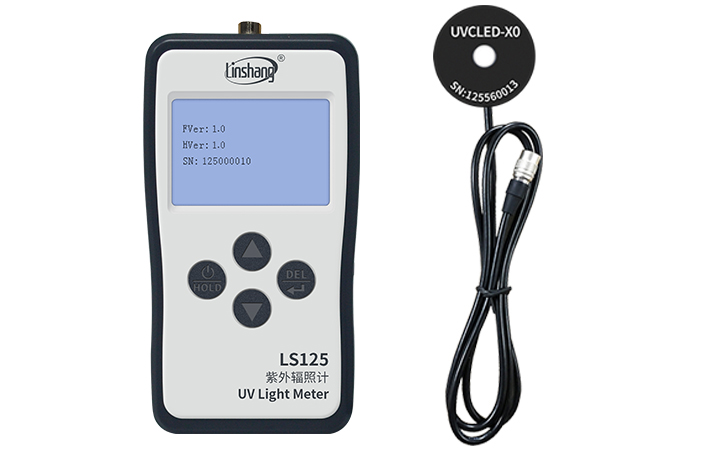
The UV meter above — a dedicated ultraviolet radiometer with a remote probe — represents the direct-measurement tier: point the sensor at the light source or lay it on the display surface, and the screen reports UV irradiance in the units conservation practice uses.
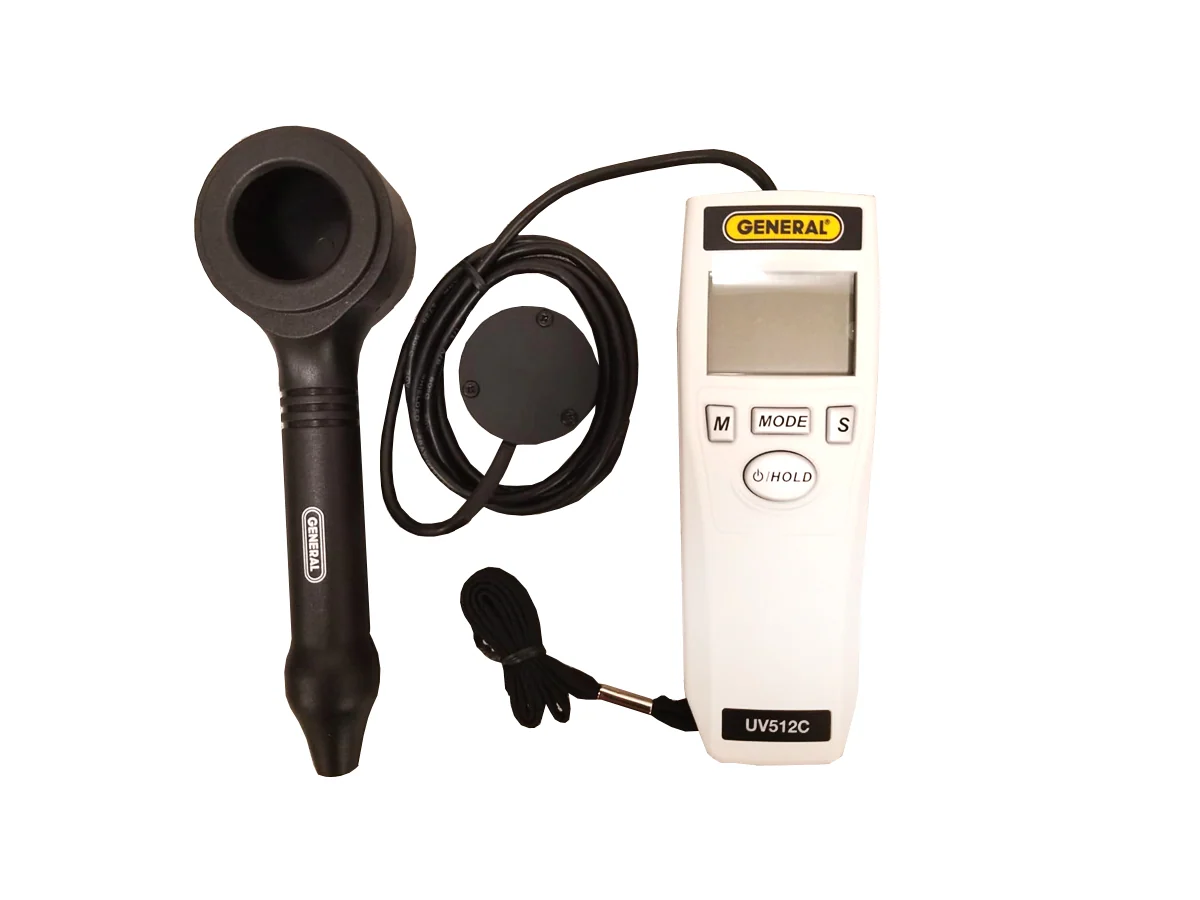
The handheld meter above — a consumer UVA/UVB unit with a wand-style sensor — is the budget workhorse of the same category: widely available, battery-powered, and accurate enough for the 75 microwatts-per-lumen pass/fail test.
The Fifteen-Minute Survey: Where to Point, What You'll See
The measurement protocol is quick once the tools are in hand. Take readings at five positions: the sunny window at noon, the display shelf across from the window, the interior-wall display, the desk spot under ceiling lights, and the dark storage closet. At each position, record lux with the sensor parallel to where a card would sit, and take the UV ratio or UV index at the same spot.

The survey chart shows the pattern every collector's room produces. The sunny window delivers thirty-thousand-plus lux and a UV index at maximum — disqualifying for any card, always, behind any glass. The bright shelf across from the window still reads a UV index around sixty-five — window glass blocks only about a quarter of UV-A, so the indirect daylight pouring across that shelf is carrying most of the dose. The interior-wall LED display reads 150 lux with a near-zero UV index — the conservation target zone. The desk under mixed lighting sits in between depending on bulb type. And the dark closet reads essentially zero — which is the entire point of the archive tier.
Two procedural rules make the survey trustworthy. First, follow the museum timing discipline: measure in the morning and the afternoon in any room with windows, because the sun's angle changes the dose dramatically across the day — a shelf that's safe at 9 a.m. can be in full indirect daylight by 3 p.m. Second, calibrate your instruments with the conservation field's own trick: hold the UV meter under an ordinary 60-watt incandescent bulb, which should read approximately 75 microwatts per lumen; if your meter drifts toward 100 under that known source, the instrument itself needs recalibration before you trust any of its readings.
For rooms with shifting daylight, one upgrade closes the measurement gap entirely: a datalogger — a small two-sensor unit that records light and UV continuously, downloading after weeks or months. Conservation programs use them precisely where daylight levels fluctuate, because they capture the annual lux-hour dose — the cumulative figure that actually predicts fading — rather than the single snapshot a handheld survey produces.
Market Analysis: A Measurement Market the Hobby Borrowed
The instrument market behind all of this wasn't built for collectors — which is exactly why it's affordable. The window tint meter category, driven by automotive and architectural film installation, was valued at roughly $45 million in 2023 and is growing at about 5.8 percent annually through 2030, with thousands of supplier listings and factory-calibrated handhelds at forty to sixty dollars for the popular LS160-class units and ninety to one hundred forty dollars for the three-channel models that read visible, UV, and infrared simultaneously.

The tier chart maps the adoption reality: phone apps dominate ownership but fail on accuracy; the forty-to-sixty-dollar tint meter tier is where serious collectors should be — simultaneous UV rejection and transmission readings through any glazing; the mid-tier dedicated UV meters serve the purists; and dataloggers remain the professional-vault tool. The professional-buying checklist the industry publishes transfers verbatim to collectors: verify the measured spectra — visible around 380 to 780 nanometers, UVA 315 to 380, UVB 280 to 315 — demand accuracy of plus or minus one to two percent, and insist on calibration traceable to national standards, because an uncalibrated meter is a guess with a screen.
User Analysis: Four Measurement Personas
The measuring collector divides into four profiles. The man cave curator wants the room certified once and forgotten: he runs the fifteen-minute survey, films the offending windows, relocates or rotates the vulnerable displays, and re-audits seasonally — the DOI protocol in miniature. The apartment renter measures before mounting anything, because adhesive-only display decisions become permanent fast and a lux reading across the candidate wall is the cheapest insurance in the hobby. The investor-collector logs the readings alongside the inventory — lux and UV figures beside cert numbers — turning environmental data into the custody documentation insurers and consignors ask for. And the content creator measures for the camera: lux levels at the shooting station, flicker checks under the filming lights, and UV readings that validate the UV-filtering claim printed on the display cases appearing in frame.
Operational Structure Analysis: Calibration as the Trust Layer
The instrument supply chain runs on a single trust mechanism: calibration traceable to national standards. Professional meters ship with certificates from accredited labs, drift over time, and return for recalibration on a schedule — which is why the incandescent-bulb sanity check matters so much for the collector tier: it's a free, instant verification that a budget meter hasn't drifted out of truth. The manufacturing layer concentrates in Asia-Pacific, which keeps prices at consumer levels but puts the verification burden on the buyer — read the reviews, check the calibration claim, and run the 60-watt test on day one. And the data layer has gone consumer: app-connected meters logging readings to phones, Bluetooth dataloggers charting seasonal curves, and smart plugs reporting lighting hours — the infrastructure of museum environmental monitoring, repriced for the man cave.
Upgrade Iteration Data
The measurement habit itself has generations.

Generation one was the eyeball — "it seems fine," the least accurate instrument ever deployed against a cumulative threat. Generation two was the phone lux app: real numbers, twenty-to-thirty-percent error, good enough to catch a sunny shelf, not good enough to certify a room. Generation three paired a dedicated lux meter with a UV monitor: the museum standard, accurate to single-digit lux and the 75-microwatt ratio, at under a hundred dollars combined. Generation four adds continuous datalogging and seasonal audits — the institutional pattern of permanent environmental records. Each generation's cost was trivial against the value it measured; the curve's lesson is that accuracy got cheap long before fading did.
Common Mistakes
Measuring once, at noon, in summer. The DOI protocol exists because doses move with season, sun angle, and fixture changes — a single reading certifies a moment, not a room.
Trusting the phone app as a UV meter. Phone sensors measure visible light only; they are blind to ultraviolet by design. You cannot measure UV radiation with a device whose sensor filters it out.
Reading lux alone. Brightness and UV dose decouple — a dim north window can out-dose a bright LED wall. The 75 microwatts-per-lumen ratio is the metric, and it needs both instruments.
Skipping the calibration check. A drifted meter certifies bad rooms as safe. The 60-watt incandescent test takes one minute and costs nothing.
Ignoring the afternoon. Morning readings in a windowed room systematically understate the dose; the protocol demands both ends of the day precisely because the sun moves.
Measuring the room but not the fixtures. A UV-filtering case over a high-UV bulb position still leaks dose at the seams — measure at the card position, not the room average.
Conclusion
A sports card man cave should be the safest room in the house for the things it holds, and the only thing standing between that ideal and a slow fade is measurement. UV radiation doesn't announce itself — it accumulates in a ledger your eyes can't read — but the ledger is fully measurable: lux at the card position, the microwatts-per-lumen ratio against the 75-point line, the seasonal re-audit when the light changes, and the datalogger curve if you want the whole truth. The tools cost less than a single mid-tier slab, the survey takes fifteen minutes, and the pass/fail answer ends every argument about sunny shelves and safe corners. The collector who measures has stopped guessing — and in a hobby where irreversible damage is the only kind, the measured room is the only room worth collecting in.





