

UV damage treats a Pokémon holofoil and a 1956 Topps Mantle like two different species — because chemically, they are. The question collectors increasingly ask as trading card games overtake sports in grading volume — 16.8 million TCG cards graded in 2025 against 10 million sports cards — has a physics answer that changes how each collection should be stored, displayed, and rotated. The short version: sports cards die from the paper and ink outward; TCG cards die from the foil surface inward. Both fade under ultraviolet. They just don't fade the same way, and the protocol that protects one category is incomplete for the other.
The Physics Split: Paper-First vs Foil-First

The vulnerability profile chart shows the split clearly. TCG cards dominate the foil-oxidation and textured-surface axes — their damage signature is optical, happening in the layered metallic surfaces that make Pokémon and anime chase cards shimmer. Sports cards dominate the ink-fade and border-yellowing axes — their damage signature is material, happening in decades-old paper stock and ink formulations that were never designed to outlive their era. UV damage is universal; its entry point is category-specific.
How UV Kills a TCG Card
The Pokémon holofoil is a laminated optical object. Beneath the printed face sits a thin metallic layer bonded to the card stock — the same class of material as the chrome finishes and holograms that the hobby watched degrade through the 1990s. Under sustained UV, that reflective layer oxidizes: the mirror brightness dulls, the rainbow shift flattens, and the card loses exactly the property that made it a chase card. This is not theoretical — holofoil oxidation is the documented failure mode, distinct from ink fade, where the reflective layer tarnishes under UV load while the printed colors beneath may still look fresh. A faded holofoil reads as tired from across the table; a clean one glows. The grade inside the slab stays frozen; the visual tier the market actually prices collapses.
The texture layer compounds it. The 2026 TCG market runs heavily on textured surfaces — the Kayou anime lines with their embossed brushstroke and UV-textured finishes, the Starlight glitter fields, the special illustration rares with layered foil treatments. Textured surfaces present more surface area to light, show micro-scratching more visibly, and carry the added insult of static: the same triboelectric charge that makes acrylic a dust magnet pulls airborne particles into foil micro-cracks, where they grind during handling in ways smooth surfaces forgive. Anime TCG guides now treat UV sensitivity as a first-class material property of these cards specifically — preservation protocols call for 90-day display rotations and strict no-sun rules precisely because the textured foil families degrade fastest.
And the color hierarchy punishes the most popular cards first. UV breaks warm-tone dyes fastest — reds and yellows die before blues — which is why fire-type holos show fade damage before water-types, and why a Charizard's orange-red palette, the most collected artwork in the hobby, is also the most UV-perishable.
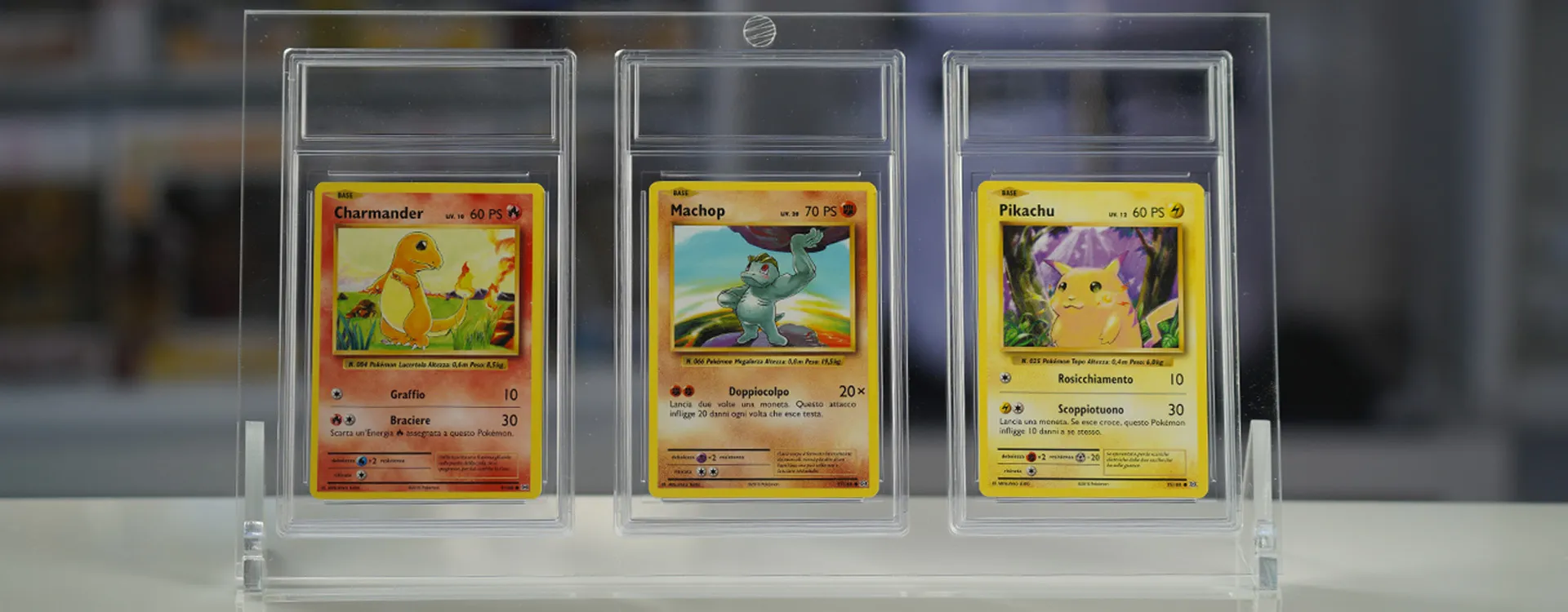
The three slabs above — Charmander, Machop, Pikachu in a clear acrylic display stand — show the category's signature display format: maximum visibility, which is exactly the exposure trade the TCG collector makes daily. The Pokémon TCG market graded 16.1 million cards in 2025 alone; PSA graded 1.5 million Pikachu cards in a single year, nearly matching the 1.6 million Michael Jordan cards graded across thirty-five. That volume makes TCG-specific UV discipline the single largest preservation audience in the hobby.
How UV Kills a Sports Card
Sports cards fail through their materials. Vintage stock — the pre-1980 cardboard that carries the Mantles and Mays — contains residual lignin and early ink formulations that show UV damage faster than modern prints, and the damage compounds: photo-oxidation yellows borders on a grade-deducting schedule, inks bleach unevenly, and the paper itself embrittles. The grading rubrics price all of it: slight border yellowing costs a full grade point, noticeable fading two to three, and the deduction lands directly on the price — a PSA 10 can be worth several multiples of the same card in a PSA 8, so a two-point fade event is a value event, not a cosmetic one.
Modern sports stock inverts the vulnerability. Contemporary printing uses far more stable pigments, so the ink survives — but the chrome, Prizm, and opti-chrome surfaces oxidize exactly like TCG foils, and the autograph tier adds a third clock: blue Sharpie, the signing-table default for decades, fades measurably faster than any printed element on the card.
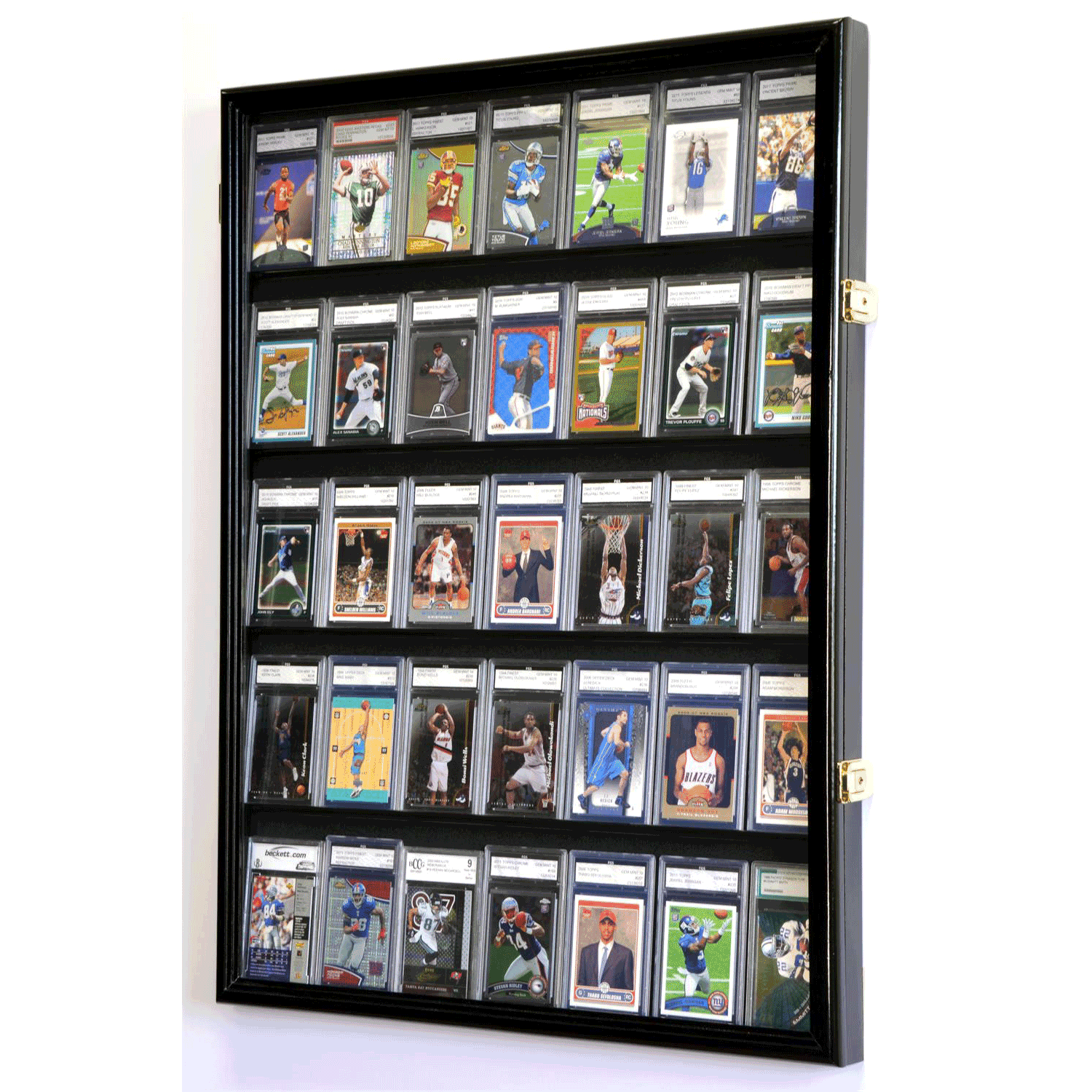
The thirty-five-slab wall cabinet above — the classic sports display format — shows the sports collector's equivalent exposure bargain: dense, visible, permanent, and completely dependent on the glazing and the room because the cards behind it span sixty years of incompatible chemistry.
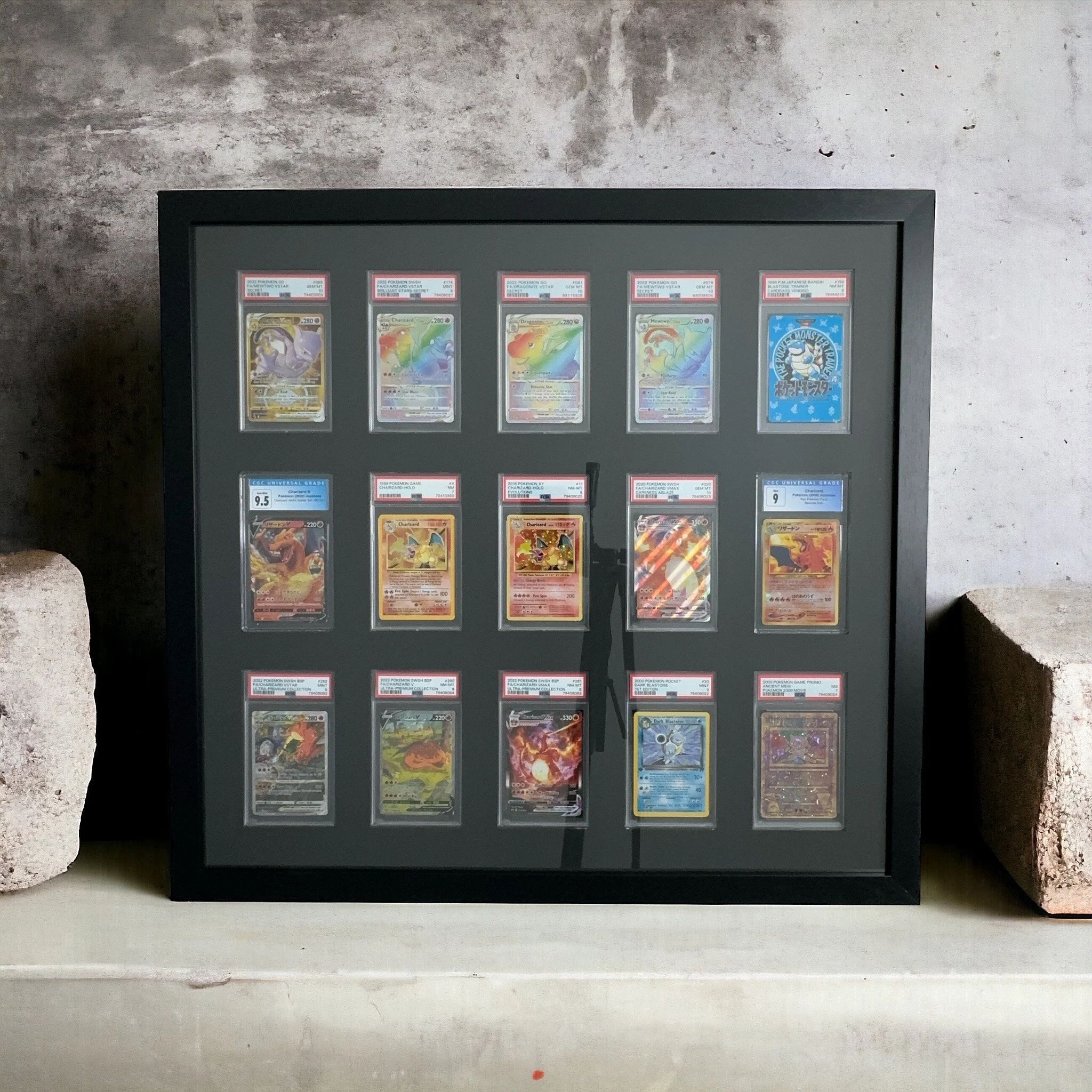
The TCG wall frame above — fifteen graded slabs in a matte-black grid — shows how completely the display formats have converged: the Pokémon collector and the sports collector now buy the same hardware, even though the materials behind the acrylic face opposite UV threats.
Market Analysis: The Volume Shift Rewrites the Protection Market
The grading data makes this the defining question of 2026. In 2025, TCG and non-sports grading surged 95 percent to 16.8 million cards while sports declined 12 percent to 10 million — the first year TCG volume exceeded sports, roughly two-to-one in non-sports' favor across the industry. PSA captured 72 percent of the total market but its growth engine flipped: sports grading was flat at plus 2 percent while its TCG volume exploded 97 percent, and by June 2026 TCG represented 71 percent of PSA's monthly grading volume. CGC grew 121 percent on the strength of Pokémon-tailored services, capturing a quarter of the TCG market.

The protection market follows volume: the collector cohort that needs foil-aware UV discipline is now the larger cohort, and the accessory industry has responded with TCG-specific content — texture-safe handling guidance, foil-rotation schedules, and display cases marketed on UV specs to a buyer base whose most-graded character out-grades the most-graded athlete six to one.
User Analysis: Four Collector Personas
The era-and-category collector divides into four profiles. The TCG-native collector — often newer, often younger, often first exposed through Pokémon — treats UV rotation as normal because the anime-card preservation guides built it into the category from the start; for this cohort, a 90-day display rotation is default behavior. The sports veteran applies decades of paper-card instinct to a collection that increasingly includes TCG pieces bought for crossover value, and under-weights foil oxidation because it wasn't in the vocabulary when he learned the hobby. The anime specialist — One Piece, Lorcana, Kayou — carries the strictest texture discipline in the hobby and treats static control as part of UV protection because the two fight over the same foil surface. The dual-collection investor holds both categories in one room and faces the protocol fork directly: the wall that protects the Mantle with short display windows underuses the stable modern stock, and the wall that happily displays Chrome rainbow sets overdoses the vintage corner.
Operational Structure Analysis: A Grading Industry That Split Along Category Lines
The institutional layer formalizes the divide. CGC's explosive 2025 growth — 121 percent, driven by Pokémon-specific services and bulk pricing — built a TCG-first grading lane where foil-condition grading standards and preservation expectations are native. PSA's sports dominance — 76 percent of sports grading, the red label commanding the highest resale premiums — keeps the paper-and-ink risk priced at the label level, while its TCG surge forces the same company to speak both preservation languages. SGC's position as the vintage specialist, with 27.7 percent of its 2025 volume pre-1980, anchors the strictest preservation niche of all. And the consolidation of SGC and Beckett under Collectors alongside PSA concentrates the market's category intelligence while leaving the era-specific storage decisions — as always — with the collector. The operational result is a supply chain now producing era-specific guidance at scale: vintage-border audits for the sports wall, foil-rotation calendars for the TCG wall, and shared hardware serving both.
Upgrade Iteration Data: Two Protocols, Converging Hardware
The preservation histories of the two hobbies ran in parallel until the hardware converged.

TCG collectors adopted foil-aware rotation and texture-safe handling early — the anime-card guides baked 90-day rotations into the category's culture — while lagging on the autograph and border-yellowing disciplines that sports collectors take for granted. Sports collectors ran the inverse pattern: border audits and autograph budgets are mature practices, while foil-oxidation awareness arrived late, imported from the TCG side as crossover collecting grew. Both cohorts reached the shared floor simultaneously — UV case spec sheets at 95-plus percent are now table stakes in both markets — and the convergence point is the modern display case itself: one enclosure, two vulnerability profiles, two rotation calendars behind the same acrylic.
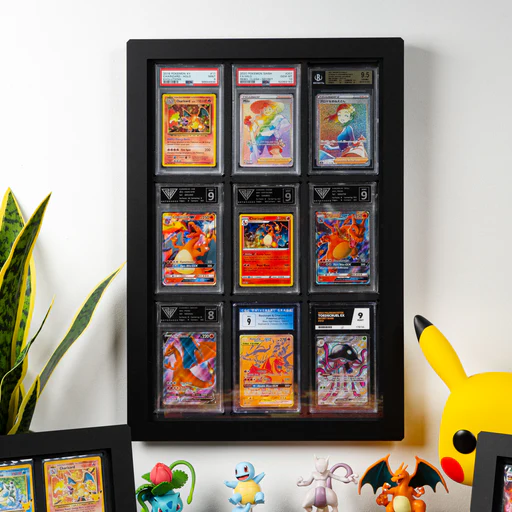
The display above — a single frame holding PSA, CGC, Beckett, and VAG slabs of the same character — is the convergence made literal: multiple grading companies, one category, one UV threat. The collector who owns that frame owns the modern TCG problem in miniature.
The Split Protocol, Summarized
The practical rules by category. TCG: rotate foils on ninety-day windows, inspect for reflectivity loss rather than color loss, control static because dust-in-foil is a UV-adjacent grinding hazard, and assume the reddest cards in the collection fade first. Sports: audit borders annually against baseline photographs, budget autograph ink as the limiting clock on any signed slab, treat vintage stock to the strictest lux limits in the hobby, and inspect modern chrome for surface dulling rather than ink fade. Both: no direct sun in any quantity, window film on every room that displays either, LED lighting on timers as the only safe source, and graded slabs understood as providing no meaningful UV defense regardless of what they hold.
Common Mistakes
Treating TCG foils like paper. The foil fails optically before the ink fails chemically; inspections that look only at color miss the reflectivity loss buyers price first.
Treating sports chrome like vintage. Modern chrome shares the TCG failure mode — foil oxidation — and the vintage-trained collector's paper instincts don't catch it.
Applying one rotation schedule to a mixed room. The vintage corner and the TCG wall need different calendars even inside the same cabinet.
Assuming grading-era modern stock is immune. Contemporary pigments are stable; contemporary surfaces are not. The distinction decides which inspection to run.
Ignoring the category data. The collector whose room skews TCG now owns the hobby's largest UV-vulnerable inventory by volume; the protocol should reflect the collection, not the collector's first hobby.
Conclusion
So — does UV affect Pokémon and TCG cards differently than sports cards? Yes, at every level that matters: different failure modes, different inspection signatures, different rotation calendars, and now, a different market weight behind each. Sports cards demand paper-and-ink discipline — border audits, autograph budgets, and the strictest lux limits for the vintage tier that holds value through every correction. TCG cards demand foil-and-surface discipline — reflectivity inspections, texture-aware handling, static control, and rotation schedules that respect how fast a shimmering holofoil can go matte. The hardware has converged — same cases, same UV spec sheets, same LEDs — but the protocols behind the acrylic remain category-specific, and the collector running a mixed room is really running two preservation systems. The 26.8 million slabs graded last year include more Pokémon than every sport combined, which means UV damage is now, by volume, mostly a TCG problem wearing a universal threat. The answer to the title's question is the collector's action item: know which chemistry your collection carries, and let that chemistry — not habit — set the rules.





