You have nine PSA 10s. Or twenty. Or thirty-six. Each one cost you hundreds in grading fees, months of waiting, and countless hours of hunting. Now they sit in a storage box, hidden from the world, their holographic foils catching nothing but dust.
That ends today.
The multi-slab display case is the game-changer that transforms a hidden collection into a gallery-worthy showcase. But with options ranging from budget foam frames to premium hardwood cabinets, how do you choose the right one? At Kaapai, we engineer multi-slab solutions for every collector level. This guide breaks down the 9-slot, 20-slot, and 36-slot showdown—so you can make the clear choice.
Why Multi-Slab Displays Dominate in 2026
The single-slab case is perfect for your grail card. But when you have a complete set, a themed collection, or a graded investment portfolio, individual cases become impractical. A wall of twenty single-slab cases costs $1,000+, requires twenty sets of mounting hardware, and looks like a scattered mosaic rather than a cohesive display.
Multi-slab cases solve this with:
-
Unified presentation — One frame, one vision, one stunning wall piece
-
Cost efficiency — Premium multi-slab cases cost $3–$5 per slot vs. $15–$60 for individual cases
-
Simplified installation — One mount point, one level, one perfect alignment
-
Enhanced security — Lockable doors protect your entire collection behind a single barrier
In 2026, collectors are moving from "card storage" to "collection curation." The multi-slab display is the centerpiece of that evolution.
The Three Contenders: 9-Slot vs. 20-Slot vs. 36-Slot
9-Slot: The Starter Gallery
The 9-slot format (typically arranged 3×3) is the entry point for serious multi-slab display. It's large enough to showcase a complete evolution line, a color-themed set, or your top nine investments—without overwhelming your wall space.
Best for:
-
New collectors building their first graded wall
-
Themed mini-collections (e.g., all Eeveelutions, rookie QBs, or 1st Edition holos)
-
Desk-adjacent or shelf displays where wall space is limited
Key features to demand:
-
Precision-cut foam or acrylic slots with zero wobble
-
99%+ UV-blocking front panel
-
Wall-mount hardware included
-
Optional: LED backlighting compatibility
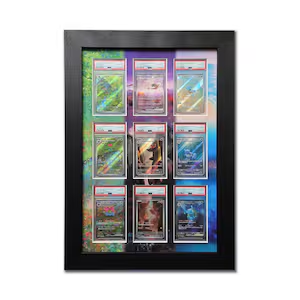
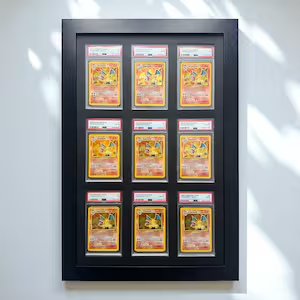
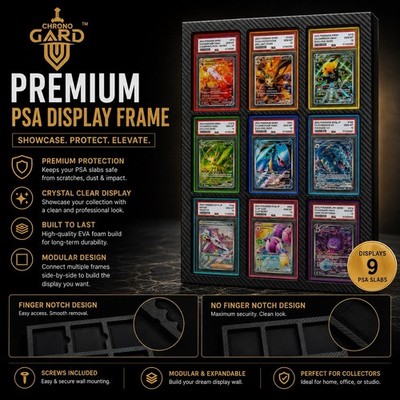
9-slot display frames in 3×3 grid configuration—perfect for themed mini-collections and starter galleries.
Kaapai Recommendation: Our 9-Slot Carbon-Fiber Wall Panel features precision-molded EVA foam slots, 99.6% UV-blocking cast acrylic front, and modular side-connectors for future expansion.
20-Slot: The Serious Collector's Sweet Spot
The 20-slot format (typically 4×5 or 5×4) hits the sweet spot between showcase impact and manageable size. It's the format most recommended by collectors on r/baseballcards and r/PokémonTCG for value-per-slab pricing.
Best for:
-
Complete set displays (e.g., full Pokémon Gym Leader set)
-
Investment portfolios requiring visible, secure storage
-
Content creators needing backdrop-worthy wall installations
-
Rooms with medium-sized feature walls
Key features to demand:
-
Adjustable slot spacing for mixed slab thicknesses (PSA vs. BGS vs. CGC)
-
Lockable door or tamper-resistant closure
-
Hardwood or aluminum frame for structural rigidity
-
Integrated cable channels for optional LED strips
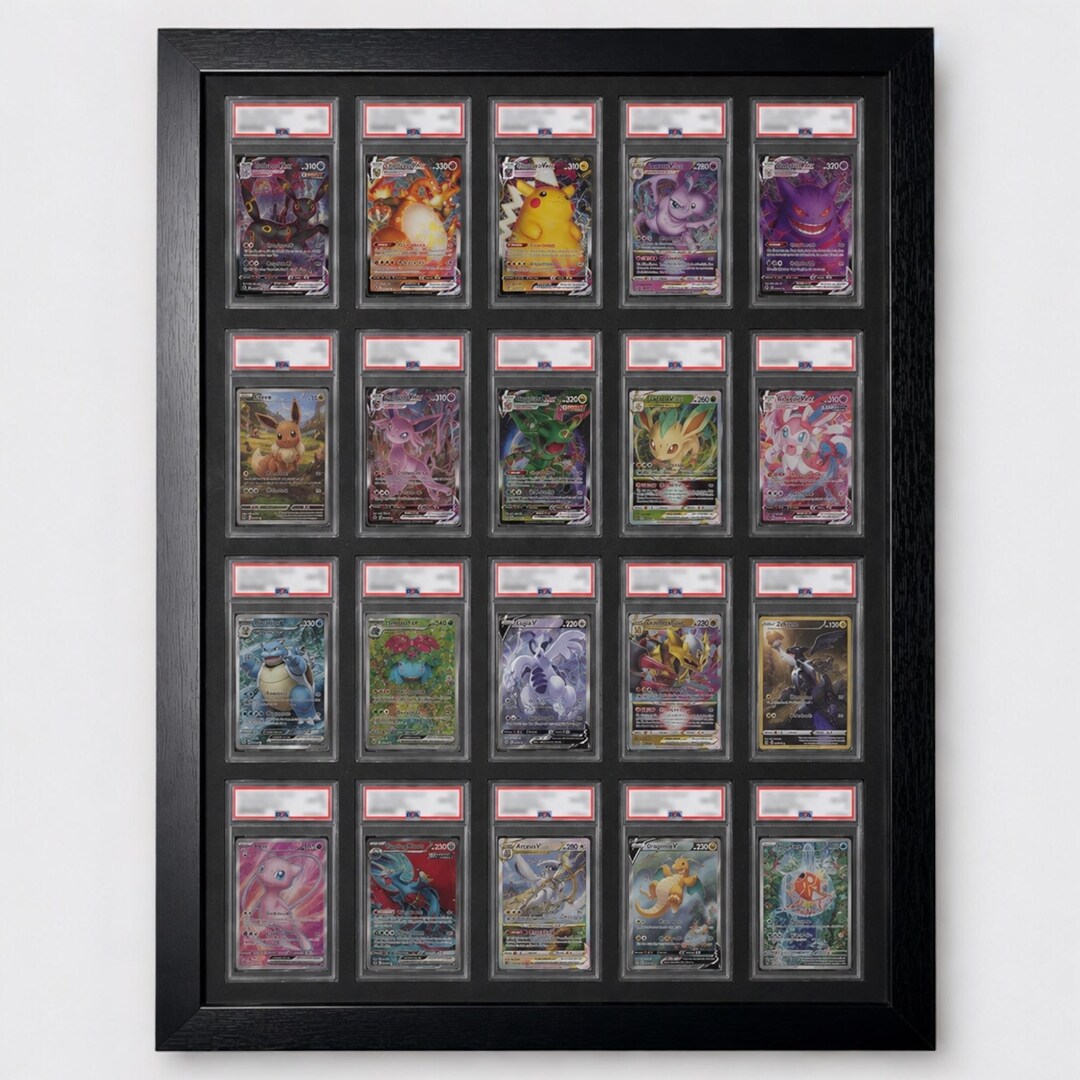
20-slot display frames in 4×5 grid configuration offer the best value-per-slab for serious collectors building gallery walls.
Kaapai Recommendation: Our 20-Slot Gallery Frame features a solid hardwood construction with UV-filtering acrylic door, dual brass locks, and wall-mount hardware. Available in black, cherry, walnut, and golden oak finishes.
36-Slot: The Collection Wall
The 36-slot format (typically 6×6) is for collectors who have moved beyond "hobby" into "archive." This is the format that turns a room into a museum.
Best for:
-
Complete vintage set preservation
-
High-volume investors with 50+ graded slabs
-
Content creators and streamers building iconic backdrops
-
Dedicated collector rooms or man caves
Key features to demand:
-
Heavy-duty wall anchors rated for 20+ pounds
-
Reinforced frame construction (solid wood or aluminum)
-
Climate-ready interior (sealable, humidity-compatible)
-
Professional-grade UV filtration (99.6%+)
-
Optional: Electronic locking with keypad or biometric access
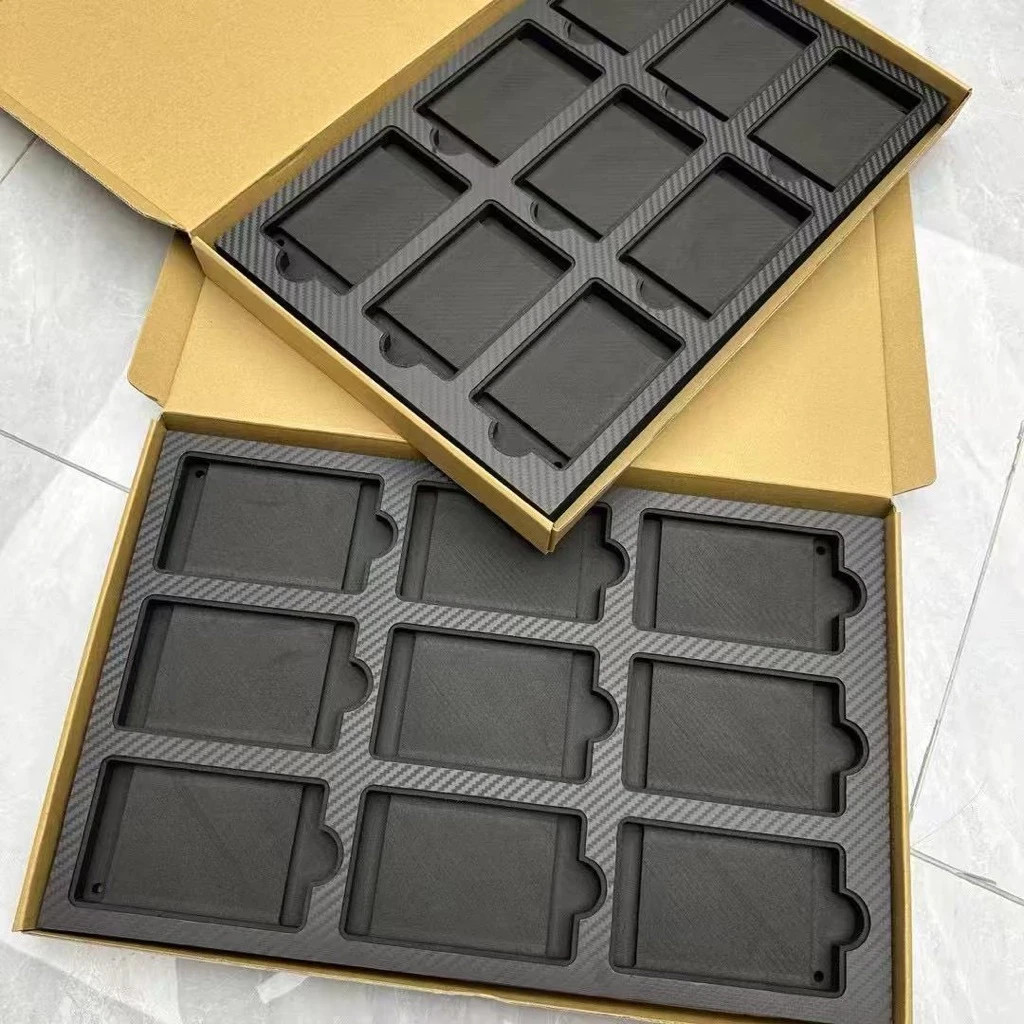
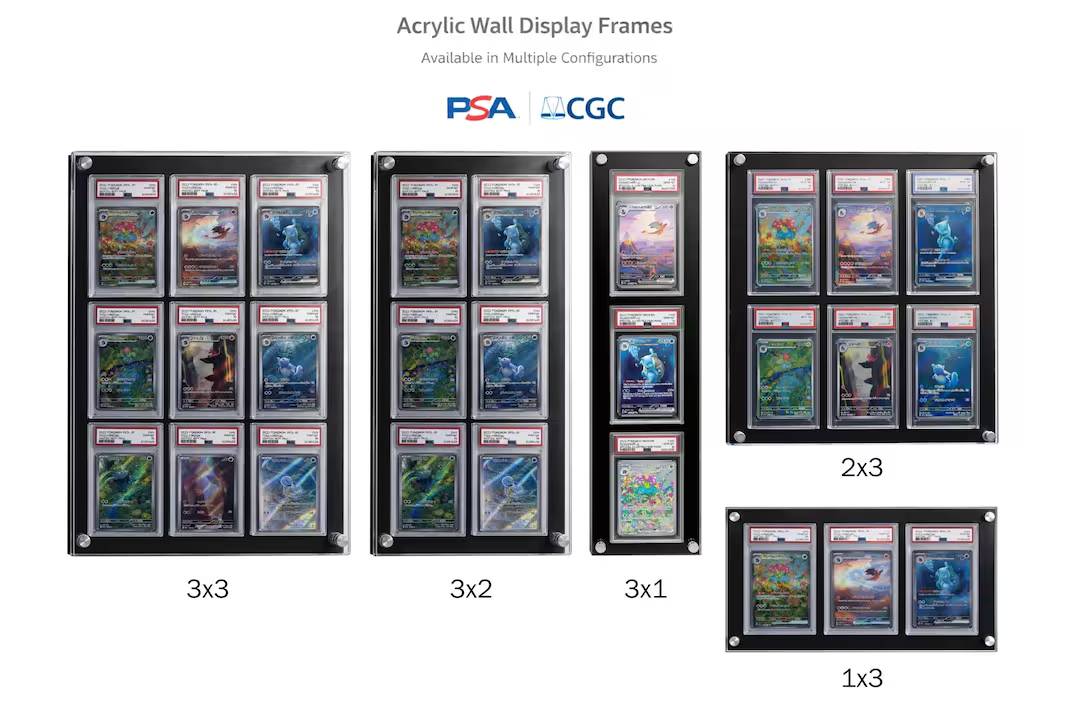
36+ slot carbon-fiber foam trays and large-capacity wall panels for serious collection archiving and museum-grade display.
Kaapai Recommendation: Our 36-Slot Vault Panel features aircraft-grade aluminum framing, 99.6% UV-blocking crystal acrylic, and modular expansion connectors. Pair with our Vault Series Cabinet for lockable, climate-controlled storage.
Material Showdown: What Separates Premium from Budget
Not all multi-slab cases are created equal. Here's how the materials stack up:
| Material | 9-Slot | 20-Slot | 36-Slot | Pros | Cons |
|---|---|---|---|---|---|
| Carbon-Fiber Foam | ✓ | ✓ | ✓ | Lightweight, modern aesthetic, excellent shock absorption | Less premium feel than wood |
| Solid Hardwood | ✓ | ✓ | ✓ | Classic gallery look, durable, customizable finishes | Heavier, higher cost |
| Aluminum Frame | ✓ | ✓ | ✓ | Maximum durability, modern industrial look, lightweight | Can feel cold/sterile |
| Cast Acrylic Front | ✓ | ✓ | ✓ | 99.6% UV block, shatter-resistant, crystal clarity | Scratches easier than glass |
| Tempered Glass | ✓ | ✓ | — | Superior scratch resistance, premium feel | Heavy, dangerous if shattered |
The Kaapai Standard: We use carbon-fiber textured EVA foam interiors for precision fit, solid hardwood or aluminum frames for structural integrity, and 99.6% UV-blocking cast acrylic fronts for protection. No tempered glass—because one shattered panel shouldn't destroy your collection.
UV Protection: The Non-Negotiable Spec
Here's where many multi-slab cases fail. A case with 50 slabs and 0% UV protection is a fading chamber. Over months, your PSA 10 Charizard becomes a PSA 10 Charizard with washed-out orange.
The protection spectrum:
| UV Block | Impact | Suitability |
|---|---|---|
| < 50% | Visible fading in weeks | Not acceptable for any collection |
| 66–80% | Noticeable degradation in months | Budget temporary only |
| 95–98% | Solid for moderate-value collections | Acceptable for short-term |
| 99%+ | Museum-grade archival protection | Essential for serious investments |
A case blocking only 80% UV still lets 20% of harmful radiation through every single day—compounding into irreversible damage over time.
How to verify: Use a UV transmission meter ($30–$100) placed directly on the case front panel. Anything below 95% is insufficient for graded cards.
Kaapai Guarantee: All our multi-slab cases feature 99.6% UV-blocking cast acrylic, verified by independent testing. We publish our specs because we have nothing to hide.
Slab Compatibility: The Hidden Problem
PSA, BGS, and CGC slabs have different dimensions. A 9-slot case designed for PSA will leave BGS slabs loose and rattle-prone, or force CGC slabs to fit poorly.
| Grading Company | Slab Thickness | Slot Requirement |
|---|---|---|
| PSA | ~3.5mm (standard) | Standard slot depth |
| BGS | ~4.5mm (subgrades) | Deep slot required |
| CGC | ~3.5mm (variable) | Standard to deep slot |
The Kaapai Solution: Our multi-slab cases feature adjustable slot depth with removable foam inserts. One case accommodates all three major grading companies without modification. No rattling. No forced fits. No compromises.
Installation Guide: From Box to Wall
Step 1: Plan Your Layout
Lay the case on the floor and arrange your slabs in the desired order before mounting. This prevents last-minute swaps that damage wall anchors.
Step 2: Find Your Studs
For 20-slot and 36-slot cases, always mount into studs. Drywall anchors alone cannot support the weight of 20+ slabs plus frame. Use a stud finder and mark locations.
Step 3: Level and Mark
Use a 4-foot level to mark your mounting line. For multi-case installations, maintain consistent 2-inch gaps between frames for a professional gallery look.
Step 4: Install Hardware
For hardwood cases: Use the included wall-mount brackets and screws. For aluminum frames: Use the integrated keyhole hangers or optional French cleat system.
Step 5: Load and Lock
Insert slabs from the bottom up to prevent top-heaviness. Engage locks if equipped. Step back and admire your collection wall.
Lighting Integration: Making Your Multi-Slab Wall Shine
The right lighting transforms a multi-slab case from storage into art:
-
Neutral white 4000K–5000K LEDs — Accurate color rendering for all card types
-
Angled at 30–45° — Minimizes glare on slab surfaces
-
Dimmable controls — Reduce intensity during non-viewing hours
-
RGB accent options — Match lighting to collection themes (red for Pokémon, blue for sports, gold for vintage)
Kaapai Integration: Our 20-slot and 36-slot cases include pre-wired LED channels with hidden cable management. Add our optional LED kit for plug-and-play illumination.
Kaapai Multi-Slab Product Line
| Product | Capacity | Material | UV Block | Lockable | Best For |
|---|---|---|---|---|---|
| 9-Slot Carbon Panel | 9 slabs | Carbon-fiber foam + acrylic | 99.6% | No | Starter galleries, themed sets |
| 20-Slot Gallery Frame | 20 slabs | Solid hardwood + acrylic door | 99.6% | Yes (dual brass) | Serious collectors, content creators |
| 36-Slot Vault Panel | 36 slabs | Aluminum + crystal acrylic | 99.6% | Optional electronic | Archive collections, investors |
| Expandable Modular System | Unlimited | Mix and match | 99.6% | Case-dependent | Growing collections, custom walls |
Available on Shopify, Amazon, and directly at kaapai.com.
Final Thoughts: Your Collection Deserves a Wall
A multi-slab display case in 2026 isn't just storage—it's a statement. It says you've moved beyond collecting pieces to curating a collection. It says your investments deserve visibility, protection, and respect.
Whether you start with a 9-slot starter panel or go all-in on a 36-slot vault installation, the principle is the same: graded cards belong on walls, not in boxes.
Choose the right capacity. Demand real UV protection. Verify slab compatibility. And never settle for a display that treats your collection like an afterthought.
At Kaapai, we build cases worthy of the grades you've earned.
Your slabs are perfect. Your wall should be too.
Shop Kaapai Multi-Slab Display Cases → kaapai.com
Frequently Asked Questions (FAQ)
Q1: What's the best multi-slab display size for a beginner?
A: The 9-slot (3×3) panel is the ideal starting point. It's large enough to showcase a themed mini-collection or your top nine cards, but compact enough for limited wall space or desk-adjacent display. As your collection grows, Kaapai's modular system allows you to connect additional panels side-by-side for seamless expansion.
Q2: Can I mix PSA, BGS, and CGC slabs in the same multi-slab case?
A: Only if the case has adjustable slot depths. Standard cases designed for PSA dimensions will leave BGS slabs loose (causing rattling and edge wear) or force CGC slabs to fit poorly. Kaapai's multi-slab cases feature removable foam inserts with adjustable depth, accommodating all three major grading companies in one unified display.
Q3: Is 99.6% UV protection really necessary for a multi-slab case?
A: Yes—especially for multi-slab cases where you're displaying your entire collection simultaneously. A case with only 80% UV blocking lets 20% of harmful radiation through daily, causing irreversible fading across all displayed cards over time. With 20–36 slabs exposed, the cumulative damage is catastrophic. Museum-grade 99.6% UV filtration is non-negotiable for serious collections.
Q4: How do I mount a 36-slot case safely?
A: For 20-slot and 36-slot cases, always mount into wall studs. The combined weight of the frame plus 20–36 slabs exceeds what drywall anchors can safely support. Use a stud finder to locate studs, mark a level line, and install with the included heavy-duty brackets. For masonry or concrete walls, use appropriate anchors rated for 50+ pounds.
Q5: Can I add LED lighting to my multi-slab case after purchase?
A: Kaapai's 20-slot and 36-slot cases include pre-wired LED channels with hidden cable management, making retroactive lighting installation simple. For 9-slot cases, our optional clip-on LED bars attach to the top frame without modification. All LED kits are low-heat and compatible with dimmable controls.
Q6: What's the difference between carbon-fiber foam and hardwood frames?
A: Carbon-fiber foam panels are lightweight, shock-absorbing, and modern in aesthetic—ideal for modular, expandable installations. Hardwood frames (cherry, walnut, oak) offer a classic gallery look with superior structural rigidity and built-in lockability. Both use the same 99.6% UV-blocking acrylic fronts. Choose based on your room's decor and whether you prioritize expandability or traditional elegance.
Q7: Do multi-slab cases reduce the value of my graded cards?
A: Not if you choose the right case. A premium multi-slab case with proper slot fit, UV protection, and dust sealing preserves slab condition better than loose storage or stacking. The only risk comes from budget cases with tight slots that scratch slab edges, or zero UV protection that causes fading. Invest in quality, and your display becomes part of the preservation strategy.
Q8: How do I clean my multi-slab display case without damaging the UV coating?
A: Use a microfiber cloth slightly dampened with distilled water. Avoid ammonia-based cleaners, alcohol, or abrasive materials that can degrade UV-inhibiting coatings. For the acrylic front panel, use a dedicated acrylic cleaner. Never spray solution directly onto the case—apply to the cloth first. Clean exteriors monthly; interiors only when swapping cards.
Q9: Can I use a multi-slab case for raw (ungraded) cards in toploaders?
A: Most multi-slab cases are designed for graded slab dimensions. Raw cards in toploaders are thinner and may sit loosely or tilt forward. For mixed collections, Kaapai offers adjustable slot inserts that can accommodate both graded slabs and toploaded raw cards securely. Always verify interior slot dimensions before purchasing.
Q10: Where can I buy Kaapai multi-slab display cases?
A: Kaapai products are available on our Shopify store, Amazon, and directly through our DTC brand at kaapai.com. We offer worldwide shipping, custom sizing consultations for large installations, and a 1-year guarantee against material defects, magnet separation, and structural failure. Contact our team for personalized recommendations based on your collection size and wall space.